OpenClaw is attractive to developers because it makes agent workflows feel open-ended: tools, prompts, local context, and experiments can all live in one place. That flexibility is useful when you are still shaping the work.
The danger is treating every coding task like an OpenClaw-native problem. Most repo work needs a narrower loop: one branch, one runner, visible state, repeatable tests, and a clean handoff for review. This guide is the boundary we use when developers ask where OpenClaw fits and where Codex on a VPS is the better execution layer.
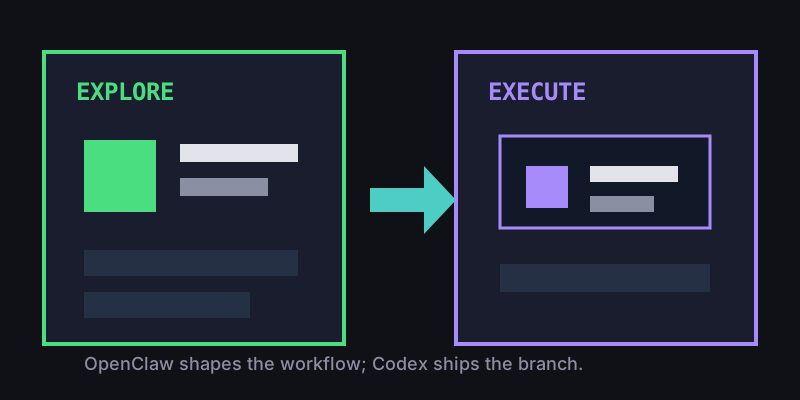
Use OpenClaw to Explore the Shape of the Work
OpenClaw is strongest when the workflow is still ambiguous. Use it to test which tools matter, discover the right prompt shape, and learn whether the job is really a coding task or a broader automation task.
A good OpenClaw exploration loop is small:
Question → inspect context → sketch workflow → run a narrow experiment → review the diffThat loop keeps the agent useful without giving it an unlimited workspace. Developers should still use normal engineering guardrails: disposable branches, short-lived credentials, explicit tool access, and tests before trust.
| Developer need | Good OpenClaw fit? | Why |
|---|---|---|
| Trying a new agent pattern | Yes | The framework is part of the learning |
| Mapping a messy cross-tool workflow | Yes | Flexibility matters more than repeatability |
| Overnight repo refactor | Not ideal | Persistence and review boundaries matter more |
| Parallel implementation branches | Usually no | One visible runner per branch is easier to supervise |
Move Repo-Centered Work to a Persistent Runner
When the task becomes mostly “read files, edit code, run tests, push a branch,” the shape changes. You do not need a broader agent canvas. You need a durable coding runner that survives laptop sleep and makes state obvious.
That is where Codex and Office Claws fit. Codex is focused on software work, and Office Claws gives that work an operational shell: VPS provisioning, Tailscale access, visible agent state, and branch-oriented supervision from the desktop app.
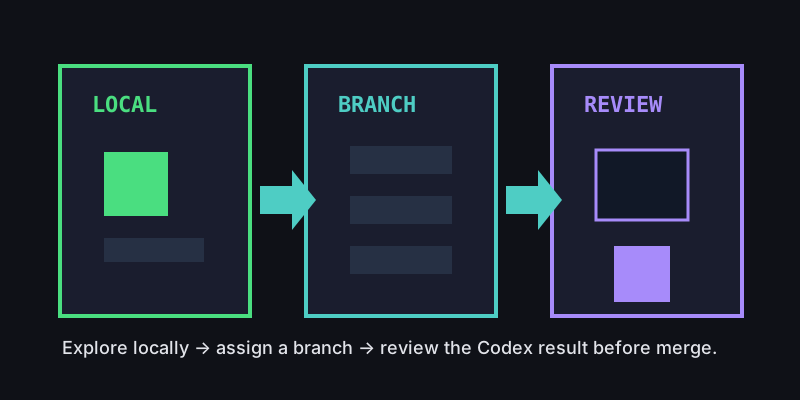
The handoff can be simple:
- Explore the task locally with OpenClaw until the implementation path is clear.
- Create a branch per coding task.
- Start a Codex runner on a VPS through Office Claws.
- Let the runner work while status stays visible in the pixel office.
- Pull the branch locally, inspect the diff, and merge only after review.
Our OpenClaw vs Codex comparison covers the tradeoff in more detail. The short version: use OpenClaw when the agent framework is the thing you are exploring; use Codex when the work is repo-centered and reviewable.
Keep the Boundary Honest
Office Claws is not an OpenClaw runtime. We do not claim native OpenClaw support, and we do not pretend every OpenClaw workflow should become a Codex workflow. The useful bridge is narrower and more honest: developers can use OpenClaw to discover the job, then move the code-heavy slice to a persistent Codex runner.
| Boundary | Keep in OpenClaw | Move to Codex with Office Claws |
|---|---|---|
| Goal | Explore a workflow | Ship a repo change |
| Runtime | Local or experimental | VPS-backed, persistent |
| Review unit | Notes, traces, experiments | Branch, diff, tests |
| Cost shape | Depends on setup | ChatGPT/Codex subscription plus VPS plan |
| Best signal | “We learned the process” | “The branch is ready to review” |
The Office Claws for OpenClaw users path is designed around that bridge. Self-Hosted is $4.99/month when you want your own DigitalOcean account. Managed is $14.99/month when you want us to handle the VPS. In both cases, the developer still reviews the branch before it lands.
Recommendation
For developers, OpenClaw is a strong exploration layer. Use it when you are discovering workflows, testing agent patterns, or connecting tools that are not purely software engineering.
Once the task becomes concrete code work, narrow the loop. Put Codex on a VPS, keep one branch per runner, watch state from Office Claws, and make review the final gate. That gives OpenClaw users the flexibility they came for without turning every coding task into an open-ended experiment.