The Alternative Question Is Really an Operations Question
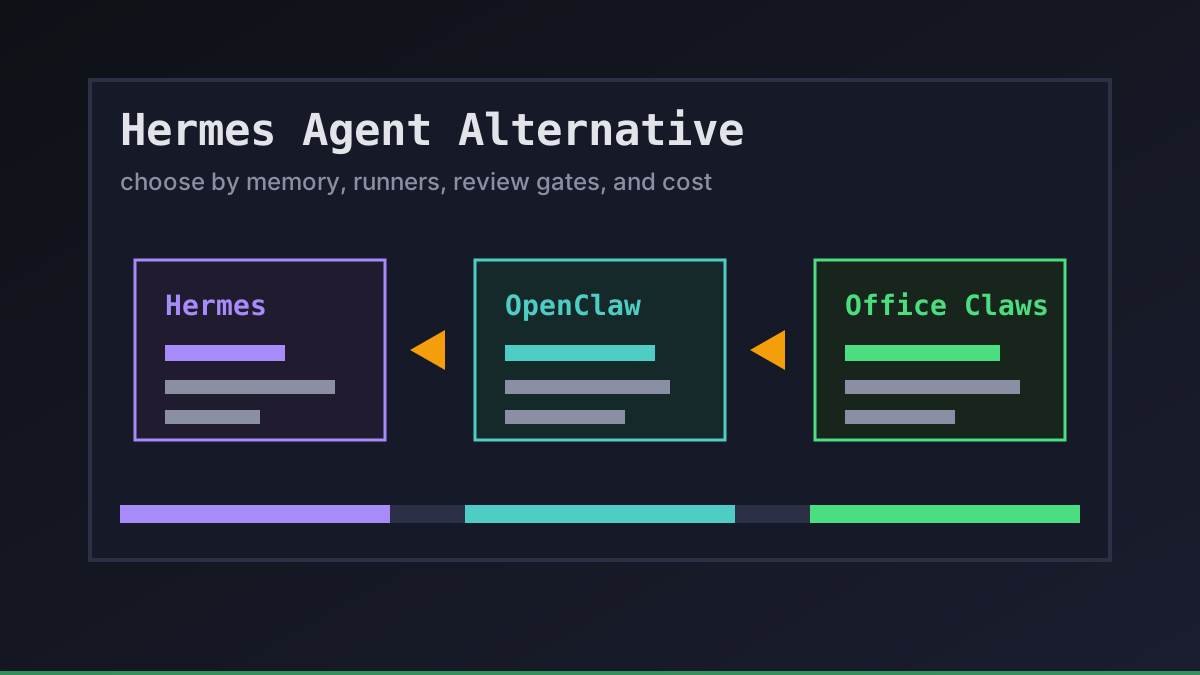
Searching for a Hermes Agent alternative usually means one of three things: you want a different autonomous agent model, you want an OpenClaw-style workflow with stronger local habits, or you want a simpler way to run coding agents on desktop and VPS runners without handing every workflow to a single hosted subscription.
Hermes Agent, from Nous Research, is interesting because it aims beyond a narrow coding CLI: persistent memory, autonomous skill creation, messaging gateways, cron, subagents, MCP, and several terminal backends. OpenClaw-style workflows are attractive for developers who want familiar autonomous coding patterns. Office Claws is separate from both; its honest role is the practical desktop/VPS operator layer for Codex-backed agents, visible logs, scoped runners, and review gates.
Hermes, OpenClaw, and Office Claws Compared
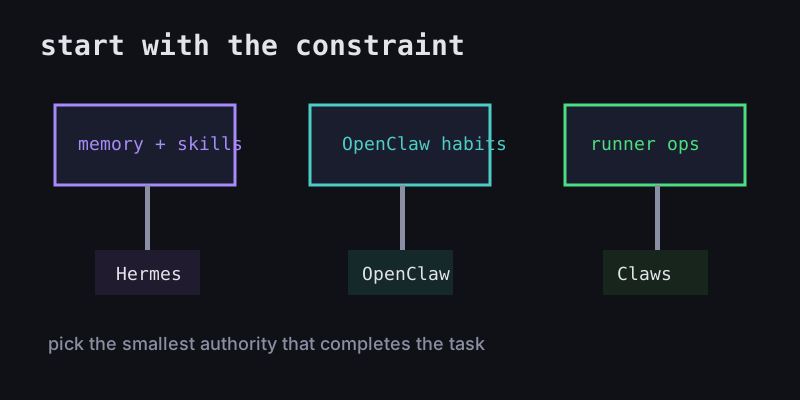
The right choice depends less on brand and more on where code runs, what the agent remembers, who can trigger it, and how production changes are reviewed.
| Need | Hermes Agent | OpenClaw-style workflow | Office Claws |
|---|---|---|---|
| Persistent agent memory | Core part of the platform | Depends on setup | Keeps operational context around runners, not a claimed Hermes/OpenClaw import |
| Autonomous skills | Strong fit for experiments | Usually more manual conventions | Treat skills and scripts as reviewed repo artifacts |
| Messaging and cron | Built-in surface to evaluate carefully | Possible with add-ons | Useful for scheduled Codex-backed runner work with owner context |
| Runtime isolation | Local, Docker, SSH, and cloud backends | Local or remote depending on setup | One task, one VPS/workdir, one branch, one log stream |
| Team review gates | Must be designed into the workflow | Usually branch/PR based | Built around branches, logs, cost visibility, and human review |
| Cost predictability | Depends on provider and backend | Depends on model/subscription/API | Self-hosted $4.99 or managed $14.99 plus Codex/API usage |
If your main requirement is a learning, cross-session agent that can grow skills and act through many surfaces, Hermes deserves a serious evaluation. If your main requirement is OpenClaw familiarity, start with OpenClaw vs Codex and OpenClaw desktop manager. If your requirement is predictable coding-agent operations, Office Claws is the boring layer we would keep in the loop.
A Safe Evaluation Path
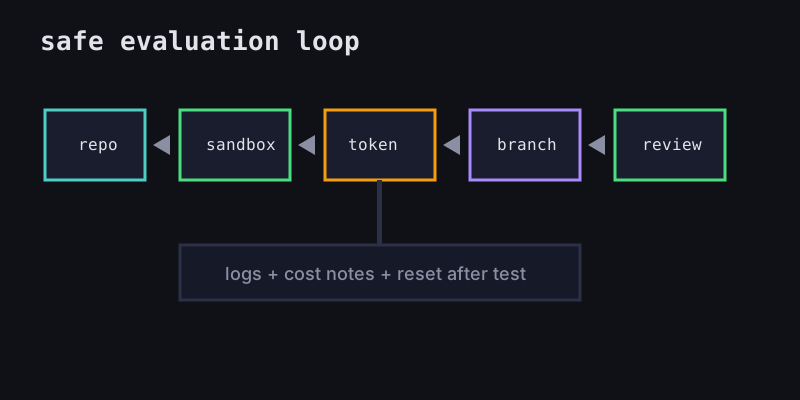
Do not evaluate alternatives by moving production permissions first. Start with a harmless repository and make the operating boundary explicit.
1. choose one repo and one low-risk issue
2. create one fresh runner or sandbox
3. give the agent one scoped token
4. require a branch and pull request
5. preserve logs, cost notes, and failure output
6. destroy or reset the runner after the test
That sequence works whether you are testing Hermes, rebuilding an OpenClaw-style workflow, or using Office Claws for OpenClaw users. It keeps the comparison practical: did the tool finish the task, keep secrets narrow, expose useful logs, and produce a reviewable diff?
When Office Claws Is the Better Alternative
Office Claws is not trying to be Hermes memory or an OpenClaw state importer. It is the better alternative when the hard part is operations: provisioning runners, watching long-running tasks, keeping agent work on branches, limiting blast radius, and understanding cost before a subscription surprise becomes the incident.
Use Office Claws when:
- the team wants Codex-backed coding agents on desktop or VPS runners;
- each task should have a clean workdir, branch, and log stream;
- humans still decide what merges and what deploys;
- secrets should stay local or scoped to a disposable runner;
- the workflow needs cost visibility more than autonomous memory.
Use Hermes when persistent memory, self-improving skills, broad messaging, or scheduled personal-agent behavior are the central experiment. Use OpenClaw-style conventions when your team already has working prompts, repo habits, and review gates that you do not want to replace.
Recommendation
Treat “alternative” as a design choice, not a winner-takes-all debate. Hermes is compelling for teams exploring learning agents. OpenClaw-style workflows remain useful for developers who want familiar autonomous coding habits. Office Claws is strongest as the control plane around safe, cost-aware, Codex-backed execution.
Our recommendation is simple: keep production authority boring. Pick the agent surface you want, but run coding changes through scoped runners, branches, logs, and human review. That is the part that survives tool churn.
Sources and Related Reading
- Hermes Agent documentation: https://hermes-agent.nousresearch.com/docs/
- NousResearch/hermes-agent on GitHub: https://github.com/NousResearch/hermes-agent
- Hermes Agent OpenClaw Migration
- Hermes Agent Security
- OpenClaw vs Codex
- OpenClaw Desktop Manager
- OpenClaw Background Tasks