Two Agents, Two Different Products
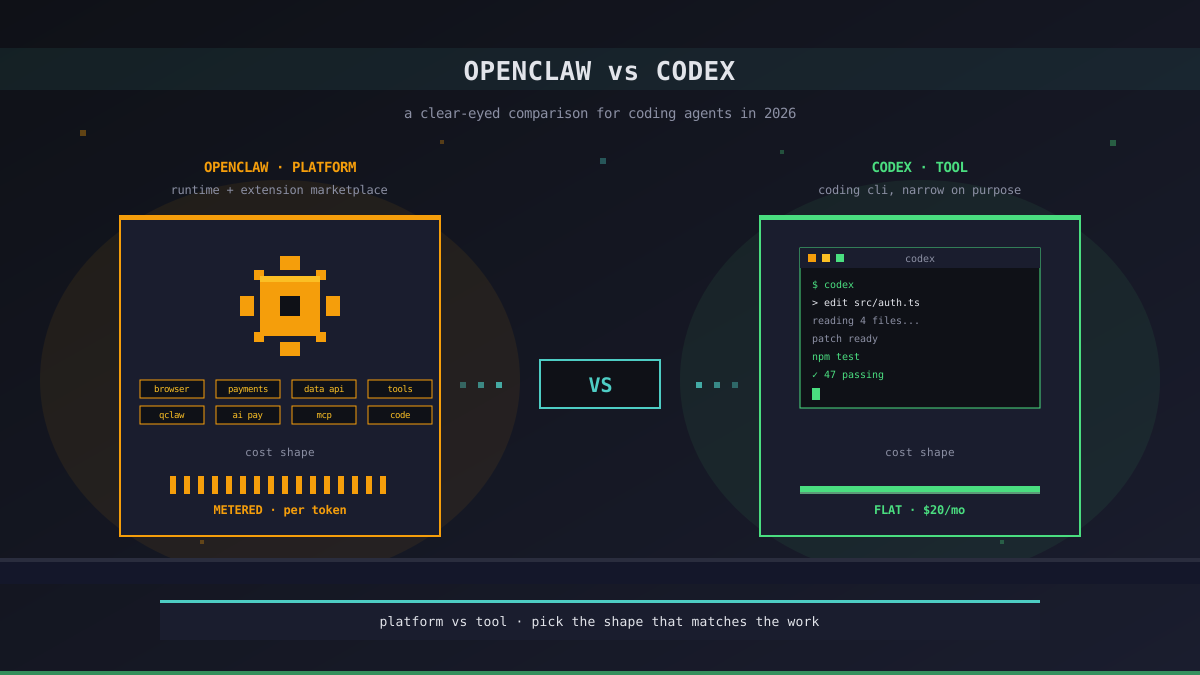
OpenClaw and Codex get bundled together in articles because they both call themselves "AI coding agents," but they are not built for the same job. OpenClaw is a general-purpose agent framework that happens to be very good at code. Codex is a coding CLI that does not pretend to be anything else. The first one is a platform; the second is a tool. Picking between them by feature checklist alone misses that.
This post is a head-to-head comparison, not a migration guide. We have one of those already — see the Codex migration path for blocked OpenClaw subscriptions if your subscription tier was the trigger that brought you here. The point of this piece is broader: if you are choosing fresh, between two agents that your team has not committed to, which one fits which workload?
Office Claws is Codex-first by design. We are not neutral and we will say so. But the comparison below is honest about where OpenClaw still wins, because pretending otherwise is how teams regret tool decisions six months later.
What Each One Actually Is
The fastest way to see the difference is to describe what each agent is the moment you install it.
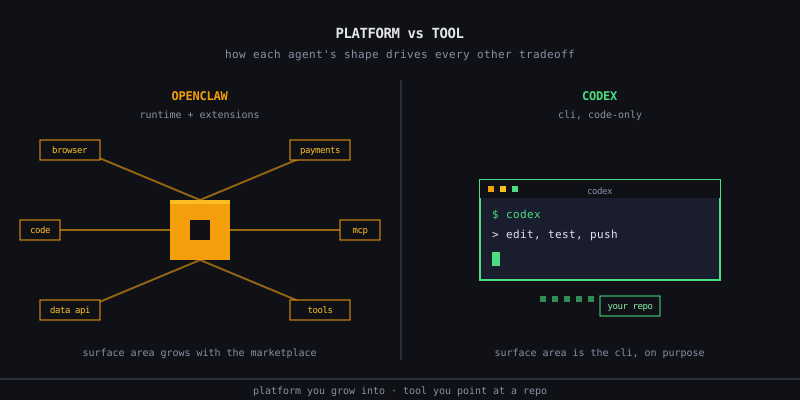
OpenClaw is a runtime plus an extension ecosystem. You install it, you point it at a model (Claude, GPT, others), and you bolt on extensions for browsers, payments, data sources, MCP servers, and whatever else the community has shipped. The agent's behaviour depends as much on the extensions you load as on the model behind it. Tencent's QClaw, Alipay's AI Pay, CoinGecko data pulls, the Rumble integration — these all live on top of OpenClaw because OpenClaw is the substrate.
Codex is OpenAI's coding CLI. You install it, you sign in with ChatGPT or an API key, and it edits code in your terminal. It reads files, writes patches, runs tests. There is no extension marketplace; the surface area is the CLI itself plus a small set of officially supported features (sandboxes, headless mode, MCP). It is narrower on purpose.
This is the choice that drives every other tradeoff downstream: a platform you grow into versus a tool you point at a repo.
| OpenClaw | Codex | |
|---|---|---|
| Shape | Agent runtime + extension marketplace | Coding CLI |
| Model backends | Multi-provider (Claude, GPT, others) | OpenAI only |
| Domain | General agent (code, browser, payments, tools) | Software engineering |
| Extension ecosystem | Large, third-party | Small, official |
| Default trust zone | Whatever extensions you install run inside the agent | Just the CLI and what you tell it to run |
The Cost Model: Where the Two Diverge Hardest
The bill shape is where the choice gets concrete. Both agents will gladly run an eight-hour coding session; the meter behind them does very different things.
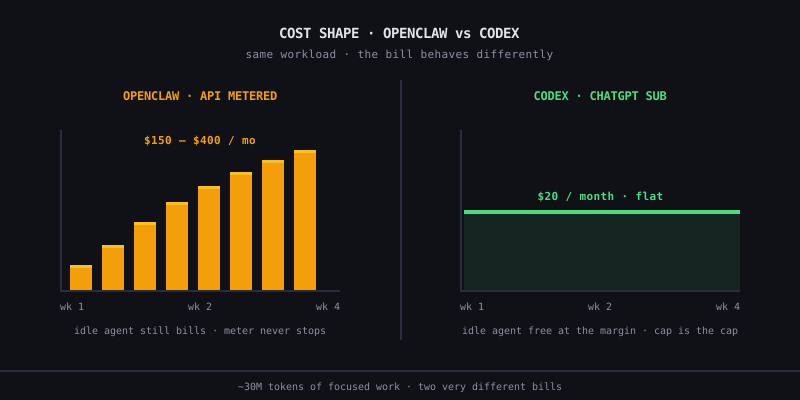
OpenClaw is currently API-billed for Claude workflows. Anthropic blocked the OpenClaw subscription tier in April 2026 — a Plus or Max plan no longer drives the agent, only an API key does. Token economics rule. A focused coding day burns 1M–3M tokens; a heavy refactor day, 5M–10M. A 30M-token month on reasoning-class Claude lands in the $150–$400 range per developer. Idle agents still bill while you sleep, because anything the agent re-reads costs something.
Codex rides ChatGPT Plus ($20/month) or Pro ($200/month). Flat fee, soft rate limits, zero marginal cost on the next request until the cap. The same eight-hour session that costs $5–$15 on the OpenClaw + Anthropic API path costs nothing extra on Codex once you have paid for the month. The cap is real but generous; most single-developer workloads stay under it.
| Cost dimension | OpenClaw (API) | Codex (subscription) |
|---|---|---|
| Bill shape | Per-token meter | Flat monthly |
| Single-dev focused month | $150–$400 | $20 (Plus) or $200 (Pro) |
| Idle agent overnight | Still billing if it re-reads | Free at the margin |
| Predictability | Spend caps are your only friend | The cap is the cap |
| Forecasting | Hard until you have a quarter of data | Trivial |
The catch — and we said this in the migration post too — is that this comparison only holds for the API path. If Anthropic ever reopens an OpenClaw subscription tier, the cost columns would converge. As of mid-2026, that has not happened.
Capability: Where Each Agent Actually Wins
Cost is half the story. The other half is what the agent is good at, which is downstream of how it was designed.
OpenClaw wins on breadth. If your workload spans more than code — driving a browser, executing payments, pulling data from non-developer APIs, orchestrating tool chains across business domains — OpenClaw was built for that and Codex was not. The QClaw consumer flows, the Alipay AI Pay integrations, the wider 2026 ecosystem of "agent that does the whole job, not just the coding part" all live here. A Codex deployment trying to do the same things will end up writing wrappers around OpenClaw-shaped problems.
Codex wins on depth in code. Inside a repo, Codex is faster, cheaper, and more predictable. The headless mode is mature, the MCP support is real, the sandbox primitives are solid, and the model behind it (GPT-5-class on Pro) is tuned for software engineering tasks. The interface is small enough that you can predict what it will do; the platform is small enough that the trust zone is too. A trojan extension is not a thing in the Codex world because there are no extensions.
Where they collide. "Just write code in this repo, run the tests, push a branch" is the overlap zone. Both agents do this. Codex does it on a flatter bill, OpenClaw does it with more flexibility about what model is behind it. For the overlap workload — and this is the bulk of paid coding-agent usage — the practical answer is Codex unless you have a reason to keep OpenClaw.
| Workload | Better fit |
|---|---|
| Pure coding sessions inside a repo | Codex |
| Eight-hour autonomous tasks on a VPS | Codex (cost) |
| Browser automation, payments, multi-tool flows | OpenClaw |
| Multi-provider model abstraction | OpenClaw |
| Strict supply-chain trust zone | Codex (no extensions) |
| Model-vendor flexibility | OpenClaw |
| Team-level audit logs and SSO | OpenClaw on API plans |
The Ecosystem Factor
Tool decisions are sticky for ecosystem reasons more than feature reasons. The honest question is which ecosystem you want to be downstream of in two years.
OpenClaw's ecosystem is wide and moving fast. New extensions, new framework integrations, new model backends — the platform-shaped product accumulates surface area quickly. The 2026 wave of "agentic" everything tilts in OpenClaw's direction by default. If you bet on OpenClaw, you are betting that the framework itself becomes the standard — Huang's "next ChatGPT" framing, however hyperbolic, is what the bet looks like.
Codex's ecosystem is narrower and slower-moving on purpose. OpenAI ships official features at OpenAI's pace; you do not get a marketplace. The upside is that the surface area you trust is small enough to actually trust. The downside is that anything OpenAI does not ship, you do not get.
For a single developer, ecosystem usually does not pay rent. For a team building a long-term agent stack, it does. Pick the one whose roadmap looks most like the workload you are betting your tooling on for the next two years.
How Office Claws Fits Either Choice
Office Claws is a desktop manager that provisions a Codex agent on your own VPS — Contabo by default, with snapshot-based provisioning that gets you to "agent online" in under three minutes. It is Codex-first because Codex's flat-fee subscription model is the one that makes 24/7 agent hosting cheap enough to justify a desktop manager around it.
We do not run OpenClaw natively. If your workload genuinely needs OpenClaw — browser automation, multi-domain agents, framework-specific integrations — Office Claws is not the right product for that slice of work. If your workload is "I want a coding agent that runs all day on a $5 VPS for less than $25/month total," that is exactly what Office Claws ships, and Codex is the agent that makes the math work.
A clean way to think about it: OpenClaw is the framework, Codex is the tool, Office Claws is the desktop layer that makes Codex pleasant to operate at scale.
Recommendation
If you are choosing fresh and 80%+ of your agent's time will be spent inside a repo, pick Codex. The bill is flatter, the trust zone is smaller, the day-to-day workflow is faster, and pairing it with Office Claws on a self-hosted VPS keeps your total cost in the low twenties per month.
If your agent's job is wider than code — payments, browsers, multi-tool orchestration, framework-native integrations — pick OpenClaw. Absorb the API bill, set spend caps aggressively, and treat Codex as a CLI you might pair with it for the coding-specific slice.
If you are coming from OpenClaw because the subscription tier got blocked, the migration guide walks through the exact swap. Most readers in that situation are in the 80%-coding bucket and will land on Codex; the post linked above is the recipe.
The choice is a platform-versus-tool one, not a feature-checklist one. Pick the shape that matches the work, not the bullet list that looks longest.
Related Reading
- OpenClaw Subscription Blocked? The Codex Migration Path — for users coming from a blocked OpenClaw subscription
- OpenClaw Security Best Practices — the threat model and the controls that mattered after the 28K incident
- Codex Subscription vs API: Which Bill Actually Costs Less — the token math behind the flat-fee argument