What Actually Changed
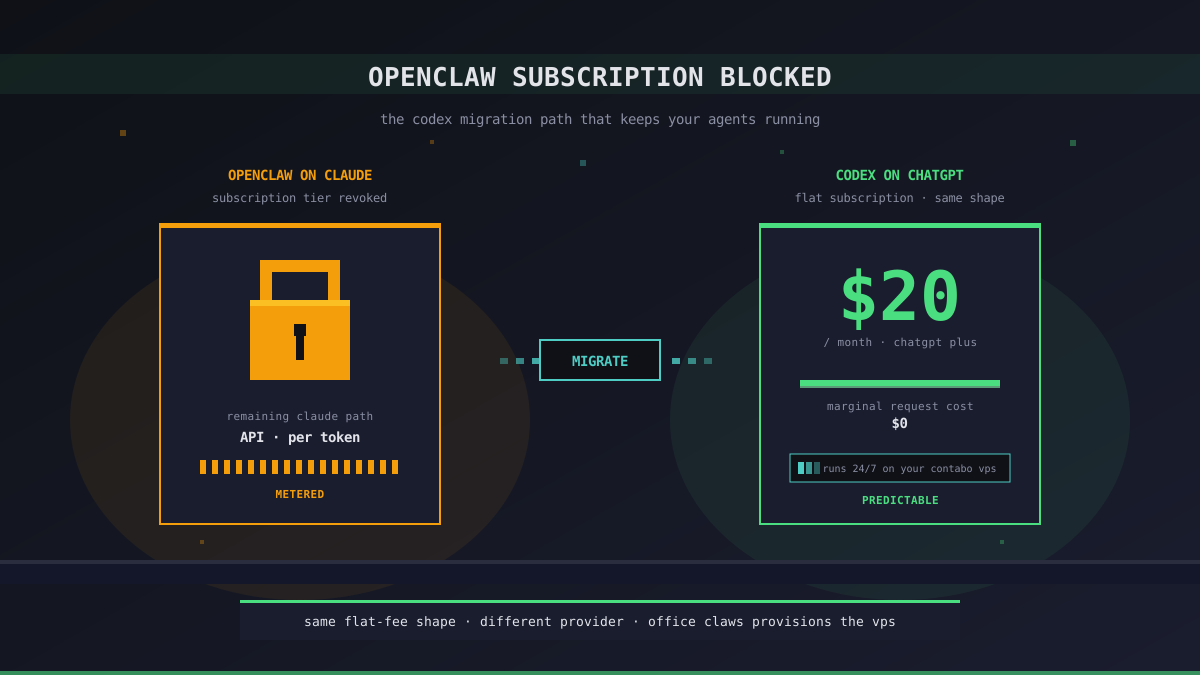
If you run OpenClaw on Claude, your subscription no longer drives the agent. Anthropic removed OpenClaw from its subscription tier. Your Plus or Max plan still answers questions in the Claude app; it no longer answers calls made by the OpenClaw runtime. The only Claude path left for OpenClaw is an Anthropic API key, billed per token.
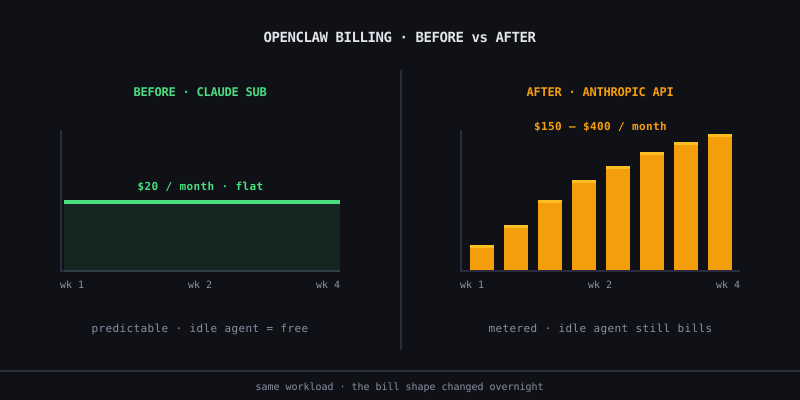
That is a bigger shift than it sounds. A fixed monthly fee has been replaced with a meter that ticks every time an agent reads a file, writes a patch, or reruns a test. For anyone whose OpenClaw agent actually did work — not demoed work, real eight-hour-a-day work — the new bill is usually several times the old one.
This post is a migration guide, not a feature post. Office Claws is not an OpenClaw runtime and we are not going to pretend it is. What we are is a Codex-first desktop manager, and Codex is the cleanest path back to the flat-fee agent workflow that OpenClaw users just lost.
Why the API Bill Hurts More Than People Expect
Back-of-envelope numbers are enough to see the shape of the problem.
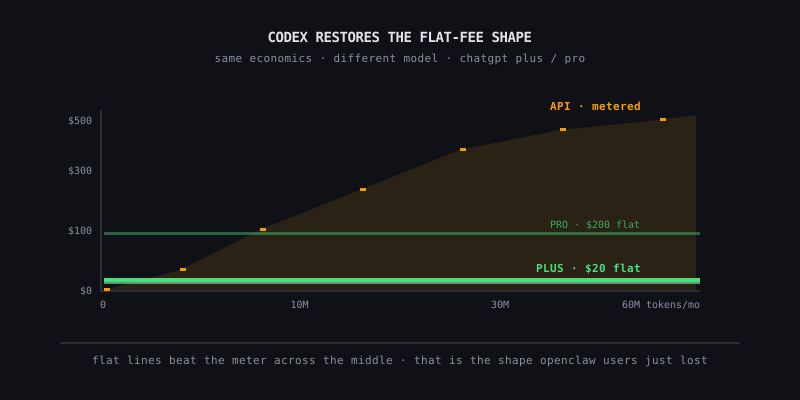
A focused coding day inside an agent — one feature, the agent holding your codebase in context, rerunning tests after each patch — is somewhere between 1M and 3M tokens across input and output. A heavy refactor day is 5M to 10M. Across twenty working days, a single developer running one agent typically burns 20M–60M tokens a month.
Anthropic's reasoning-class models are priced on the order of a few dollars per million input tokens and tens of dollars per million output tokens. A 30M-token month lands somewhere between $150 and $400, not the $20 you used to hand over for a Plus sub. For teams, multiply by seats.
| OpenClaw on Claude sub (before) | OpenClaw on Anthropic API (now) | |
|---|---|---|
| Bill shape | Flat monthly | Per-token meter |
| Typical focused-dev month | $20 | $150–$400 |
| Rate limits | Soft, message-count-based | Still exist, plus spend caps to set yourself |
| Runs while you sleep | Yes | Yes, and it keeps billing while you sleep |
The "keeps billing while you sleep" line is the one that trips people up. On the subscription, an idle agent was free at the margin. On the API, the cost of a long-running session is whatever the agent decided to read and reread while you were not watching.
The Codex Path Has the Same Shape OpenClaw Just Lost
Codex CLI pairs with ChatGPT Plus ($20/month) or Pro ($200/month) and bills on the same subscription model OpenClaw used to run under. Flat fee. Soft rate limits. Zero marginal cost on the next request until the cap. For the median single-developer workload, that is the shape you actually want back.
You do not get an OpenClaw-identical runtime out of this. You are changing the agent, not wrapping it. What you keep is the economics and the 24/7 hosting pattern.
Migration Recipe: Codex on Your Own VPS via Office Claws
This is what we ship. The recipe below is what an OpenClaw user following the migration for the first time would do with Office Claws on the self-hosted plan.
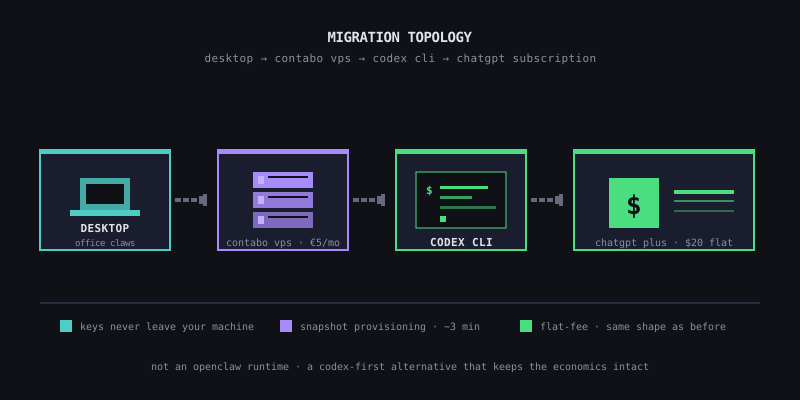
- Install Office Claws. Desktop app, Mac or Windows. Your API keys and tokens stay on your machine; nothing gets uploaded to us.
- Connect a Contabo account. Self-hosted means the VPS lives under your billing, not ours. Contabo is the provider we target — €5/month for a box that comfortably runs Codex-driven agents.
- Provision an agent. Pick a location, click through. The app builds the droplet from a pre-baked snapshot with Docker, Tailscale, and Codex CLI already installed. Typical time from click to "agent online" is under three minutes.
- Sign in to ChatGPT inside the agent. The agent runs
codex authover the Tailscale tunnel. Your Plus or Pro subscription now drives the agent, exactly like it drives your local CLI. - Point the agent at a repo. Same workflow you would have handed an OpenClaw agent — branch, task description, constraints. The agent runs on the VPS, not your laptop, so closing the lid does not kill the session.
The self-hosted plan is $4.99/month (we are running $2.99 for the first 100 users). Combined with Contabo's €5 droplet and your existing ChatGPT subscription, the total monthly cost lands in the low-twenties — the same order of magnitude as the sub OpenClaw users just lost. No per-token meter anywhere in the stack.
The Honest Tradeoff: Where OpenClaw Still Wins
Switching to Codex is not a strict upgrade. There are real reasons to keep OpenClaw on the API, and if any of these describe your workload, migration is not the right call.
- OpenClaw-specific ecosystem. If you rely on integrations built for OpenClaw — QClaw's consumer flows, Alipay AI Pay, CoinGecko data pulls, Rumble's MoonPay integration — those are OpenClaw-native and have no Codex equivalent. You are buying into the framework, not just the model.
- Task breadth outside code. OpenClaw aims at "general AI agent" territory — it can drive browsers, execute payments, operate over arbitrary tools. Codex is narrower and better at the software-engineering slice. If your agent spends half its time outside a repo, Codex is a downgrade.
- Team billing and SSO. Anthropic's API plans ship audit logs, DPAs, and per-project cost allocation. ChatGPT subscriptions do not. Finance teams that want one line item per workload still prefer metered billing.
- Multi-provider abstraction. Some teams run OpenClaw so they can swap model backends without rewriting agent code. If that abstraction layer is load-bearing, dropping to Codex flattens it.
For everyone else — one developer or a small team running coding agents eight hours a day — the Codex subscription path is the cheaper bill, the flatter forecast, and the one that stops charging you for letting the agent think.
Migration Checklist
Before you pull the trigger on switching:
- Measure one week of your current OpenClaw usage in tokens. If you are under 2M/month, the API bill was never the problem and you can stay.
- Audit which of your agent's behaviors actually depended on OpenClaw-specific tools versus generic "read files, edit files, run tests." The generic pile ports to Codex; the specific pile does not.
- Decide where the VPS lives. Self-hosted on your own Contabo account gives you full SSH and clean cost visibility. Managed removes the provisioning work but you give up the direct infra view.
- Keep your OpenClaw install around for the first month. The point is to compare real bills, not to burn a bridge.
Recommendation
If your OpenClaw workload was 80% coding and the subscription freeze just broke your budget, migrate to Codex. The Office Claws path gets you a 24/7 agent on your own VPS, driven by your ChatGPT subscription, for roughly the cost of the Anthropic plan you lost.
If your OpenClaw workload was genuinely multi-domain — payments, browser automation, tool-calling beyond code — stay on OpenClaw and absorb the API bill, or wait out whatever Anthropic does next. Codex is narrower by design; pretending otherwise is how teams regret migrations three months later.
The meter is the enemy of eight-hour coding sessions. A flat fee is the right shape for that work. That has not changed; only the provider pointing at it has.
Related Reading
- Codex Subscription vs API: Which Bill Actually Costs Less — the token math behind the flat-fee argument
- Cutting Your AI Agent Bill: A Practical Cost Guide — the three levers that actually move the token bill
- Self-Hosted vs Managed — picking the Office Claws plan that matches this migration