Two Ways to Pay for the Same Model
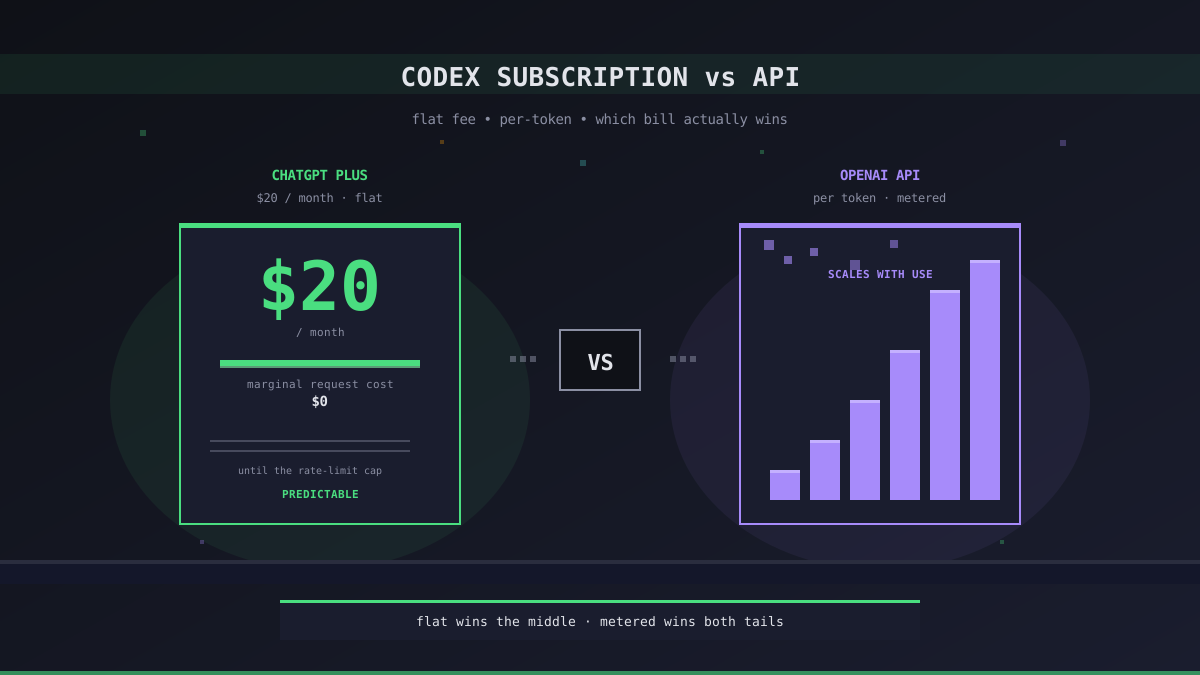
If you want Codex driving an agent inside Office Claws, you can get there two ways. You can point the Codex CLI at your ChatGPT Plus or Pro subscription and pay a flat monthly fee. Or you can plug in an OpenAI API key and pay per token. Same underlying model family, completely different bill shapes.
Most developers pick whichever they had already. That works, but it often leaves money on the table. A week of real coding work makes the answer obvious — you just have to count the tokens first.
How the Two Paths Actually Bill
The ChatGPT subscription is a ceiling. Plus is $20/month, Pro is $200/month. Both include Codex CLI access, and both throttle you by message count over a rolling window rather than by raw tokens. You hit the cap, you wait or upgrade. Until then, every additional request is free at the margin.
The OpenAI API is a meter. There is no floor and no ceiling — you pay for every input token and every output token. Reasoning-heavy coding models run roughly $5–$15 per million input tokens and $30–$60 per million output tokens. A single long conversation can move the needle on a per-developer bill.
| ChatGPT Plus | ChatGPT Pro | OpenAI API | |
|---|---|---|---|
| Shape | Flat monthly | Flat monthly | Pay-per-token |
| Price | $20/mo | $200/mo | Variable |
| Codex CLI access | Yes | Yes, higher limits | Yes, via API key |
| Marginal cost per request | $0 until cap | $0 until cap | Every token billed |
| Who pays the overage | You wait | You wait | You, immediately |
What a Coding Week Actually Burns
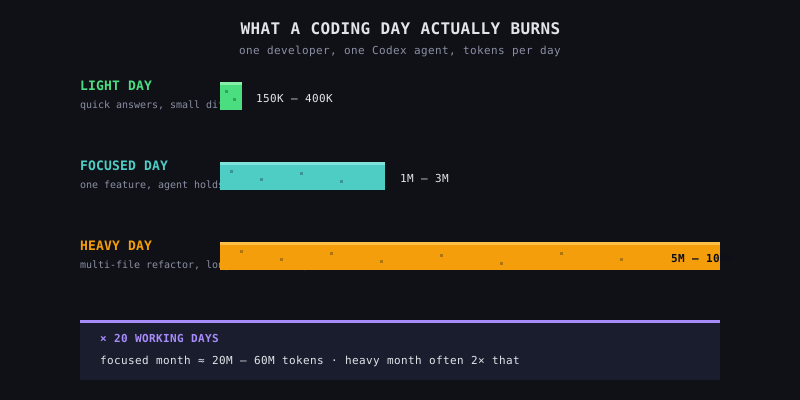
Abstract pricing sheets do not tell you whether you will hit $15 or $300 in a month. Token counts do. Here is what we see from agents running real work on Office Claws desktops:
- Light day — a few targeted questions, small diffs, no deep refactors. Around 150K–400K tokens total across input and output
- Focused day — a single feature, agent holds the codebase in context, reruns tests after each patch. 1M–3M tokens is normal
- Heavy day — multi-file refactor, agent reading dozens of files, long back-and-forth on edge cases. 5M–10M tokens is common, 20M+ is not rare
Multiply a focused day across 20 working days and you are looking at 20M–60M tokens/month from one developer running one agent. At the higher end of API pricing, that is a bill in the mid-three figures. At the lower end, it is still well north of the $20 Plus subscription.
The Break-Even
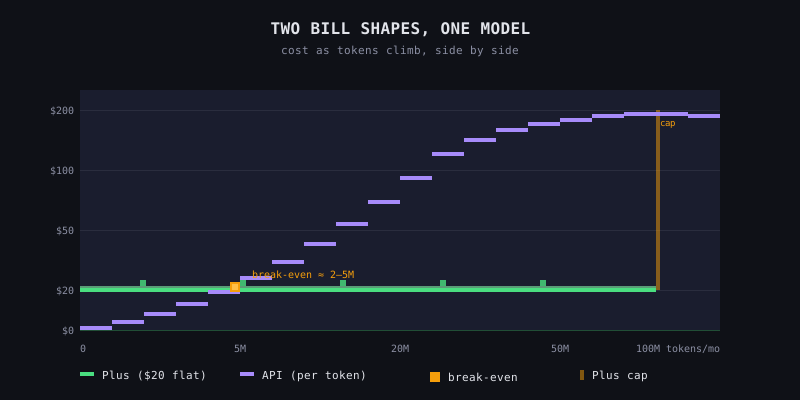
Below roughly 2M tokens a month, the API is usually cheaper. You are a hobbyist or occasional user, and Plus is overkill. This is a small population.
Between 2M and 20M tokens a month, Plus at $20 wins by a large margin — often 5× to 15× cheaper than the equivalent API bill for the same work. This is where most solo developers live.
Above 20M tokens a month, Plus starts throwing rate limits at you. Pro at $200 extends the ceiling and, on our measurements, stays cheaper than API billing up through roughly 60M–100M tokens of heavy coding work. Above that, the API's predictable per-token pricing starts to look more attractive again — mostly because you stop fighting rate limits.
Monthly tokens    Best value
-----------------------------
< 2M              OpenAI API
2M – 20M          ChatGPT Plus ($20)
20M – 80M         ChatGPT Pro ($200)
> 80M             API or multi-seat Pro
These brackets move when OpenAI reprices either product, but the shape of the curve is durable. Flat-rate plans win the middle. Metered billing wins both tails.
Where the API Still Wins
A subscription-driven workflow is not the right answer for every team. A few situations push you back toward the API:
- Cost allocation across a team — if you need per-project billing, the API's per-token granularity is worth real money in operations overhead
- Programmatic workloads — CI jobs, batch evaluations, anything that runs without a human. API keys are the contract there, not personal subscriptions
- SSO and enterprise procurement — OpenAI's business plans bundle SSO, audit logs, and DPAs that individual subscriptions do not
- Predictable monthly spend at scale — finance teams often prefer a variable bill they can model over a flat fee they cannot cap
Outside those cases, for one developer running one or two agents eight hours a day, the subscription almost always wins.
Making the Subscription Path Work on a VPS
There is a catch. Running Codex from your subscription historically meant running the CLI on your laptop, which dies when you close the lid and disappears when you move between networks. Agents that need to run for hours — builders, reviewers, anything autonomous — do not fit on a laptop.
Office Claws was built to close that gap. On the self-hosted plan ($4.99/mo, $2.99 for our first 100 users), we provision a DigitalOcean droplet with Codex CLI pre-installed, networked over Tailscale, and logged into your ChatGPT subscription. The agent runs 24/7 on the VPS. Your subscription pays for the tokens. The droplet costs a few dollars of DigitalOcean spend per month.
The result: a Codex agent that costs roughly $20/month for the model access plus a few dollars for the box. The same workload on the API would routinely land between $80 and $400 depending on how hard the agent is pushed.
A Practical Recommendation
If you are not sure which path fits:
- Start with ChatGPT Plus. $20 is cheap insurance and covers most single-developer workloads
- If you hit rate limits often enough to interrupt flow, move to Pro. The $200 is worth it if Codex is central to your day
- Only move to the API if one of the edge cases above applies, or you genuinely burn more than ~80M tokens/month
For everything in between, the subscription is the cheaper bill, the simpler one to forecast, and the one that stops punishing you for asking the agent one more question. Run it on a VPS so it actually runs when you are not watching, and the math settles.
Related Reading
- Cutting Your AI Agent Bill: A Practical Cost Guide — the three levers that actually move the token bill
- Self-Hosted vs Managed — picking the Office Claws plan that matches the workflow above