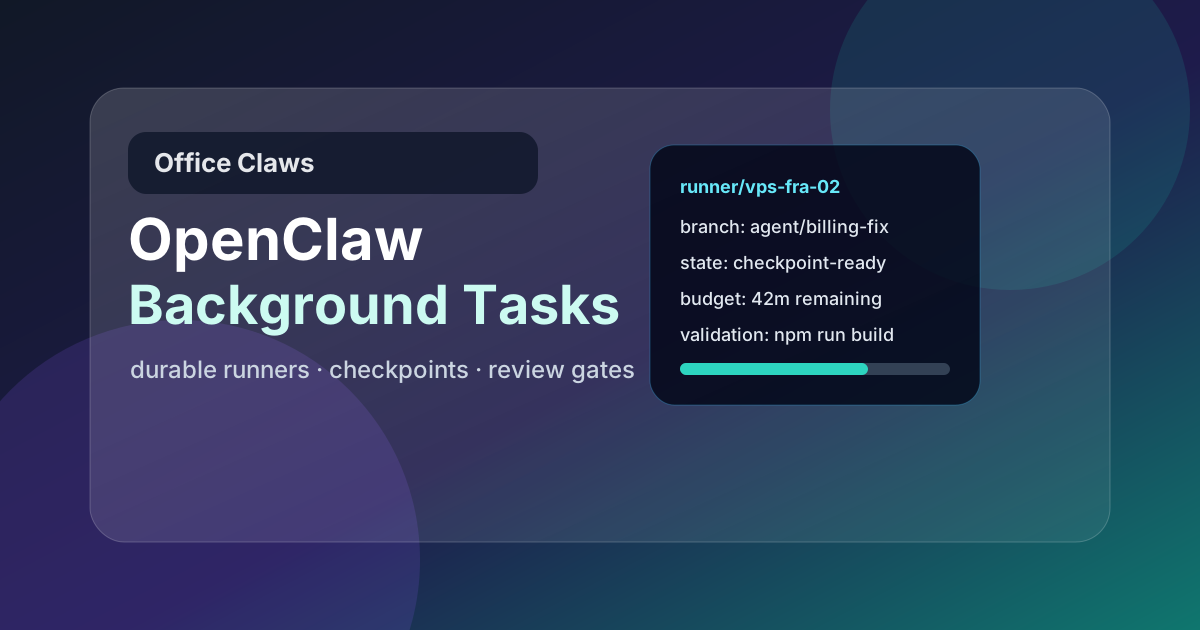
Why OpenClaw Background Tasks Need an Operating Model
OpenClaw background tasks are useful because the agent can keep moving while you review code, answer customers, or sleep. They are risky for the same reason: a silent terminal can burn tokens, mutate the wrong branch, wait forever for approval, or produce a diff nobody trusts.
Office Claws is not a native OpenClaw runtime. The honest pattern is OpenClaw-adjacent operations: a local desktop manager, isolated VPS runners, Codex-backed execution when that is the practical path, and visible checkpoints before work becomes expensive. If you are choosing the runtime first, read OpenClaw vs Codex, then use this playbook to make background work reviewable.
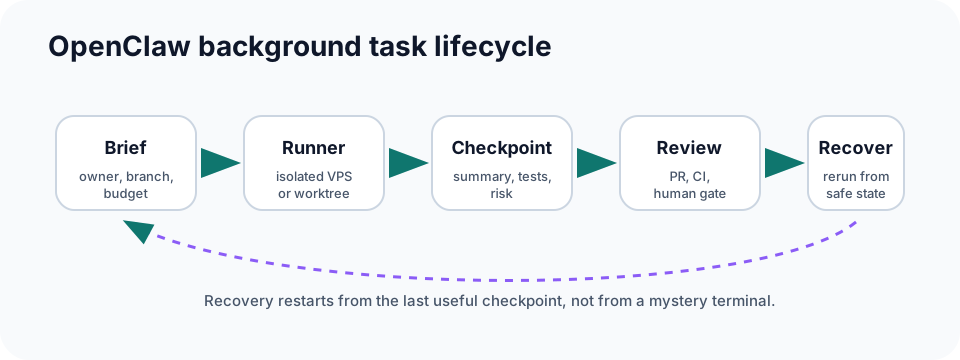
The OpenClaw Background Task Contract
A background task should start with a contract, not a vague prompt. The contract tells the runner what it owns, when it should stop, and what evidence the human needs later.
| Contract field | What to define | Safe default |
|---|---|---|
| Owner | Human, issue, or chat thread | One accountable reviewer |
| Runner | Local worktree or VPS host | One task per runner |
| Branch | Git branch and base | Fresh branch from main |
| Budget | Time, token, and diff limit | 60-90 minutes, 500 lines |
| Checkpoints | When to summarize | After setup, tests, and final diff |
| Stop rules | Conditions that require human input | Secrets, deploys, schema deletes, repeated failures |
This is where Office Claws for OpenClaw users is valuable: each task has a visible owner, runner, branch, log stream, and stop gate instead of becoming a forgotten terminal pane.
A Durable Runner Loop
A healthy OpenClaw background task repeats a small loop: plan, inspect, edit, test, checkpoint, and either continue or stop. The loop should be visible enough that another developer can reconstruct the work without reading an entire transcript.
task=openclaw-background-tasks
runner=vps-fra-02
branch=agent/fix-billing-webhook
budget=75m, max_diff=500_lines
checkpoint=after first failing test, after implementation, before push
stop_if=needs production secret, database migration is destructive, same test fails 3x
validation=npx velite build && npm run build
Pair that loop with OpenClaw monitoring so stale output, repeated retries, and runaway diffs become visible early.
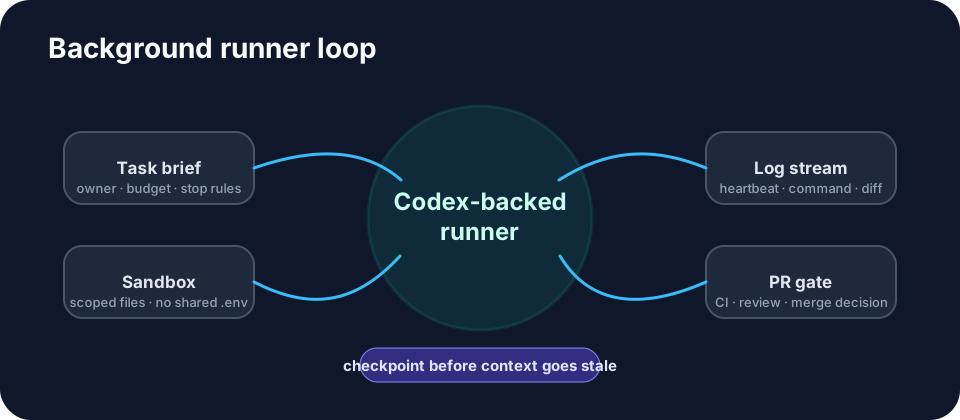
Checkpoint Messages That Are Actually Useful
The checkpoint is the difference between autonomy and mystery. Every checkpoint should answer five questions:
- What changed since the last checkpoint?
- What evidence did the runner collect?
- Which files or services are now risky?
- What command is running or failed?
- What is the next reversible step?
A useful checkpoint is short:
checkpoint=implementation-ready
changed=website/src/app/billing/*, backend/webhook.go
evidence=unit test now reproduces missing idempotency guard
risk=no production secrets touched; migration not required
next=add guard, rerun billing tests, stop if API contract changes
For longer jobs, checkpoint before context gets stale. OpenClaw long running tasks covers the reliability side; background tasks add the operator rule that silence is never a success state.
Failure Modes and Recovery
| Failure mode | Signal | Recovery |
|---|---|---|
| Waiting for input | Log stops after approval prompt | Pause task, ask owner, do not auto-approve risky actions |
| Token burn | Repeated planning or broad reads | Summarize, narrow allowed paths, restart from checkpoint |
| Wrong branch | Diff includes unrelated files | Stop runner, save patch, reset into a clean branch |
| Lost SSH session | Runner disappears but process may live | Reconnect, capture logs, inspect process before rerun |
| Flaky validation | Same command alternates pass/fail | Record environment, isolate test, avoid shipping without CI |
The security version of this problem is covered in OpenClaw sandbox and OpenClaw secrets management. Background tasks should inherit those boundaries: scoped credentials, isolated workdirs, no shared .env sprawl, and early human review for anything destructive.
Recommended Office Claws Setup
Use one task, one runner, one branch, one log stream, and one review gate. Launch background tasks from the desktop, run risky work on isolated VPS runners, keep provider keys local where possible, and push small branches for CI instead of waiting for a heroic final diff.
Office Claws gives OpenClaw-style teams desktop management, VPS runner visibility, Codex-backed execution, safer local key handling, and the recovery path needed to make background tasks boring. That is the goal: agents can work while you are away, but the work is still understandable when you return.
Related Reading
- OpenClaw vs Codex — compare runtime and execution tradeoffs.
- OpenClaw desktop manager — manage OpenClaw-style runners locally.
- OpenClaw monitoring — detect stuck or expensive agents early.
- OpenClaw sandbox — reduce blast radius for autonomous coding tasks.