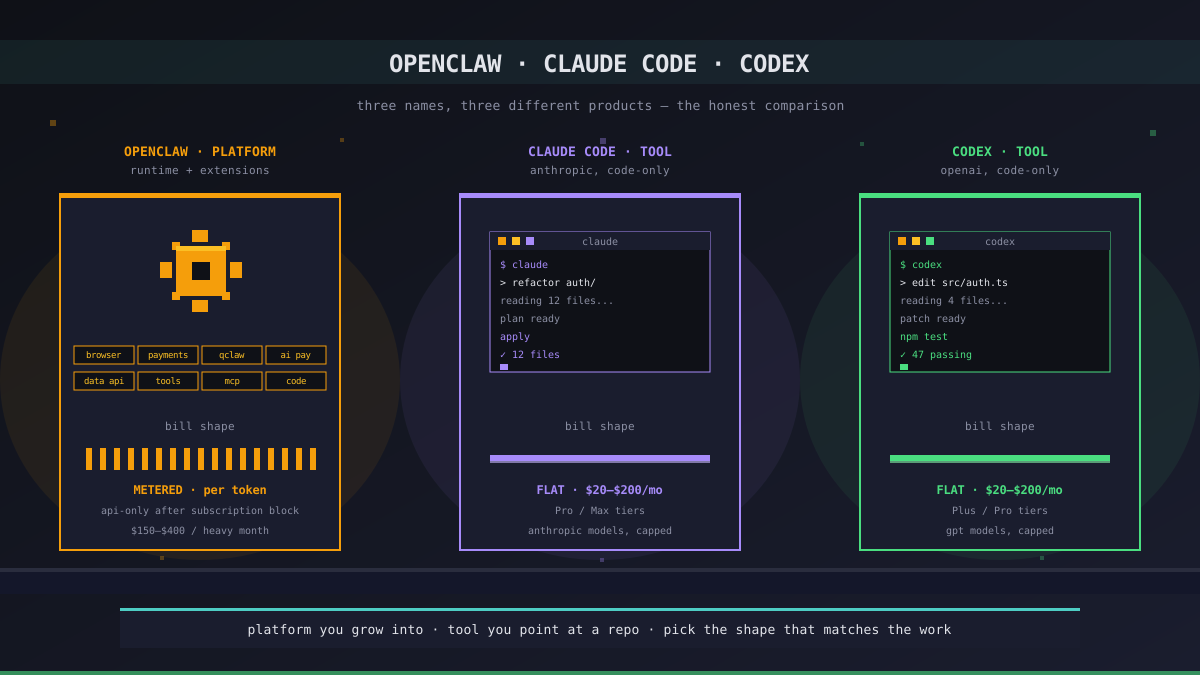
Three Names, Three Different Products
OpenClaw, Claude Code, and Codex show up in the same sentences because they all call themselves "AI coding agents." That framing flattens them. OpenClaw is a general-purpose agent runtime that happens to be good at code. Claude Code is Anthropic's coding tool, built around Anthropic's own models. Codex is OpenAI's coding CLI, built around OpenAI's models. Picking between them by feature-checklist alone misses what each one is actually for.
This is a comparison post, not a migration guide. If you landed here because your OpenClaw subscription was blocked, the Codex migration path is the recipe. If you have already committed to OpenClaw versus Codex specifically, the two-way breakdown is sharper. The point of this piece is broader: three popular agents, three different shapes, and an honest answer about which one fits which workload.
Office Claws is Codex-first by design. We will say where that bias kicks in. We will also say where the other two genuinely win, because pretending otherwise is how teams regret tool decisions six months later.
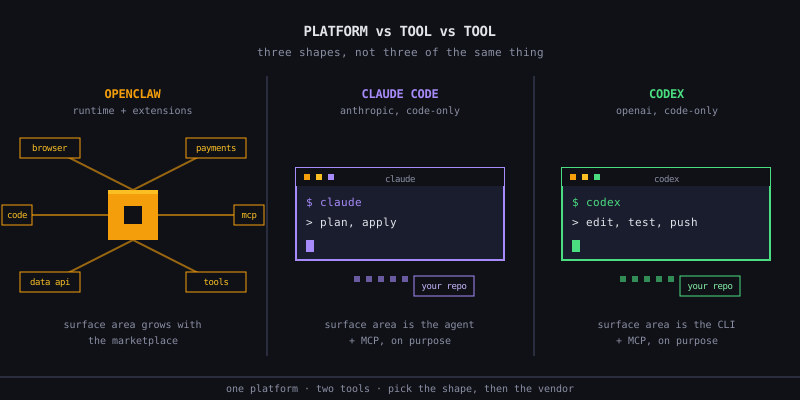
What Each One Actually Is
The easiest way to see the differences is to describe what you have the second after each one finishes installing.
OpenClaw is a runtime plus an extension marketplace. You install it, point it at a model backend (Claude, GPT, others), and bolt on extensions for browsers, payments, data sources, MCP servers, and whatever else the community has shipped. The agent's behaviour depends as much on the extensions you load as on the model behind it. Tencent's QClaw, Alipay's AI Pay, the wider 2026 ecosystem — these all sit on top of OpenClaw because OpenClaw is the substrate.
Claude Code is Anthropic's coding agent. It runs in your terminal or your IDE, signs in with a Claude Pro or Max subscription (or an Anthropic API key), and edits code by reading files, writing patches, and running commands. It is tightly bound to Anthropic's models — Sonnet and Opus — and to Anthropic's tool-use semantics. The surface area is the agent plus a small set of officially supported integrations (MCP, sub-agents, hooks). There is no third-party extension marketplace.
Codex is OpenAI's coding CLI. You install it, sign in with ChatGPT Plus or Pro (or an API key), and it edits code in your terminal. It reads files, writes patches, runs tests. Same shape as Claude Code on the surface — narrow, vendor-bound, code-only — but pointed at GPT-class models and OpenAI's subscription tiers.
| OpenClaw | Claude Code | Codex | |
|---|---|---|---|
| Shape | Agent runtime + extension marketplace | Coding agent (terminal + IDE) | Coding CLI |
| Vendor | Open framework, multi-provider | Anthropic | OpenAI |
| Model backends | Claude, GPT, others | Claude (Sonnet, Opus) | GPT-class (Codex/GPT-5) |
| Domain | General agent (code, browser, payments, tools) | Software engineering | Software engineering |
| Extension ecosystem | Large, third-party | Small, official (MCP, hooks) | Small, official (MCP) |
| Default trust zone | Whatever extensions you load | The agent + what you tell it to run | The CLI + what you tell it to run |
OpenClaw is the platform. Claude Code and Codex are the tools — same shape as each other, different vendors and different bills behind them.
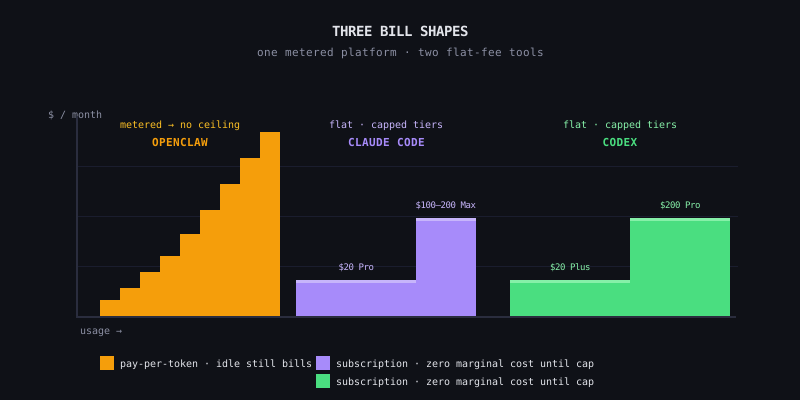
The Bill Shape: Three Curves, Not Three Numbers
Pricing is where the three diverge hardest, and it is the dimension that decides most real-world picks.
OpenClaw is currently API-billed for Claude workflows. Anthropic blocked the OpenClaw subscription tier in April 2026 — a Claude Pro or Max plan no longer drives OpenClaw, only an Anthropic API key does. Token economics rule. A focused coding day burns 1M–3M tokens; a heavy refactor day, 5M–10M. A 30M-token month on reasoning-class Claude lands in the $150–$400 range per developer. Idle agents still bill while you sleep, because anything the agent re-reads costs something.
Claude Code rides Anthropic's own subscription tiers. Claude Pro is $20/month with reasonable Claude Code usage; Max plans run $100/month and $200/month with much higher caps. Inside the cap, marginal cost is zero — the same flat-fee shape as the ChatGPT Plus model. The cap is real and Anthropic enforces it by message count over a rolling window. Heavy users at the $20 tier do hit limits during deep refactors; the $100 and $200 tiers exist precisely for that workload.
Codex rides ChatGPT Plus ($20/month) or Pro ($200/month). Flat fee, soft rate limits, zero marginal cost on the next request until the cap. The same eight-hour session that costs $5–$15 on an API path costs nothing extra on Codex once you have paid for the month.
| Cost dimension | OpenClaw (API) | Claude Code (subscription) | Codex (subscription) |
|---|---|---|---|
| Bill shape | Per-token meter | Flat monthly | Flat monthly |
| Entry price | None — pay-per-token | $20/mo (Pro) | $20/mo (Plus) |
| Heavy-usage tier | Aggressive spend caps | $100 or $200/mo (Max) | $200/mo (Pro) |
| Idle agent overnight | Still billing if it re-reads | Free at the margin | Free at the margin |
| Predictability | Hard until a quarter of data | Trivial | Trivial |
The pattern is clean: one metered platform, two flat-fee tools. If you are picking purely on bill shape, that is the axis.
Where Each One Earns the Spot
Cost is half the story. The other half is what each agent is actually good at.
OpenClaw wins on breadth. If your workload spans more than code — driving a browser, executing payments, pulling data from non-developer APIs, orchestrating tool chains across business domains — OpenClaw was built for that and the others were not. The QClaw consumer flows, the Alipay AI Pay integrations, the wider 2026 "agent that does the whole job" ecosystem all live here.
Claude Code wins on careful refactors. Anthropic's reasoning models are particularly strong at staying coherent across long multi-file changes, and Claude Code's hooks and sub-agents give it a clean way to express that workflow. Teams that have committed to Anthropic for everything else — chat, summarization, evaluations — get less context-switching when their coding agent runs on the same vendor.
Codex wins on flat-fee depth. Inside a repo, Codex is fast, predictable, and well-tuned for software engineering. The headless mode is mature, the MCP support is real, the sandbox primitives are solid. Pairing it with a ChatGPT Plus subscription you already have makes it the cheapest path to a coding agent that runs all day without thinking about the token meter.
Where they collide. "Just write code in this repo, run the tests, push a branch" is the overlap zone for all three. Codex and Claude Code are nearly interchangeable on the surface for this; OpenClaw can do the same job but burns the API-token bill while it does. For the overlap workload — and this is the bulk of paid coding-agent usage — Codex or Claude Code is the right shape; OpenClaw is the wrong tool unless you already need its breadth.
| Workload | Better fit |
|---|---|
| Pure coding sessions inside a repo | Codex or Claude Code |
| Eight-hour autonomous tasks on a VPS | Codex (flat-fee math) |
| Long multi-file refactors with reasoning | Claude Code (Max tier) |
| Browser automation, payments, multi-tool flows | OpenClaw |
| Multi-provider model abstraction | OpenClaw |
| Strict supply-chain trust zone | Codex or Claude Code |
| Predictable monthly bill | Codex or Claude Code |
| Maximum model flexibility | OpenClaw |
The Trust Zone Story
This dimension is easy to overlook until it bites. Each agent has a different trust zone — the set of code paths you implicitly authorize when you install it.
OpenClaw's trust zone is whatever extensions you load. The 28K-system trojan incident earlier in 2026 was an extension-layer compromise; the runtime itself was fine, but installed extensions had inherited filesystem and credential access. That is not a flaw unique to OpenClaw — it is the structural cost of an extension marketplace. The benefit is breadth; the cost is that supply-chain hygiene becomes your responsibility.
Claude Code and Codex have small, vendor-controlled trust zones. There is no third-party marketplace to compromise. MCP servers are explicit, named, and added by you — there is no auto-installed extension layer. The downside is that anything the vendor does not ship, you do not get. The upside is that the agent's surface area is small enough to actually trust.
For solo developers, the trust zone tradeoff usually does not pay rent — the convenience of a marketplace wins. For teams with audit logs, security review, or compliance posture, the vendor-controlled agents are an easier sell.
Trust zone size, ascending:
  Codex        ▮▮▮              (CLI + MCP you wire up)
  Claude Code  ▮▮▮▮             (agent + MCP + hooks)
  OpenClaw     ▮▮▮▮▮▮▮▮▮▮▮▮     (runtime + marketplace + every extension installed)
How Office Claws Fits
Office Claws is a desktop manager that provisions a Codex agent on your own VPS — Contabo by default, with snapshot-based provisioning that gets you to "agent online" in under three minutes. The product is Codex-first because Codex's flat-fee subscription model is the one that makes 24/7 agent hosting cheap enough to justify a desktop manager around it.
We do not run OpenClaw natively. If your workload genuinely needs OpenClaw — browser automation, multi-domain agents, framework-specific integrations — Office Claws is not the right product for that slice of work. For OpenClaw users who want to keep going after the subscription block, our role is as the manager you switch to when you migrate the coding-specific part of your workload to Codex. That is the standard anchor: Office Claws for OpenClaw users.
Claude Code is a more interesting partial overlap. The agent is excellent and the subscription bill is reasonable. We do not currently provision Claude Code agents inside Office Claws because the headless / 24/7 story is less mature than Codex's, and the cost math is harder to make work for an always-on agent on a $5 VPS. For an interactive laptop workflow, Claude Code is a fine choice; for the "agent on a box that runs while I sleep" workload that Office Claws is built around, Codex is what we ship against.
A clean way to think about it: OpenClaw is the platform you grow into, Claude Code and Codex are the tools you point at a repo, and Office Claws is the desktop layer that makes one of those tools — Codex — pleasant to operate at scale.
Recommendation
If you are choosing fresh and 80%+ of your agent's time will be spent inside a repo, pick a flat-fee tool. Codex wins when you want the agent running 24/7 on a VPS and you already have or want ChatGPT Plus — pair it with Office Claws on a self-hosted VPS and total cost lands in the low twenties per month. Claude Code wins when long reasoning passes and tight Anthropic integration matter more than 24/7 autonomy.
If your agent's job is wider than code — payments, browsers, multi-tool orchestration, framework-native integrations — pick OpenClaw. Absorb the API bill, set spend caps aggressively, and treat Codex or Claude Code as a CLI you might pair with it for the coding-specific slice.
If you are migrating from a blocked OpenClaw subscription, the migration guide walks the exact swap. Most readers in that situation land on Codex; the post linked above is the recipe.
The choice is a platform-versus-tool one, and then a vendor-versus-vendor one. Pick the shape that matches the work first, the vendor whose models you trust second, and the bill shape that does not punish your usage pattern third.
Related Reading
- OpenClaw vs Codex: A Clear-Eyed Comparison — the two-way version, sharper on the platform/tool axis
- OpenClaw Subscription Blocked? The Codex Migration Path — for users coming from a blocked OpenClaw subscription
- Codex Subscription vs API: Which Bill Actually Costs Less — the token math behind the flat-fee argument
- Self-Hosted vs Managed — picking the Office Claws plan that runs Codex on your own box