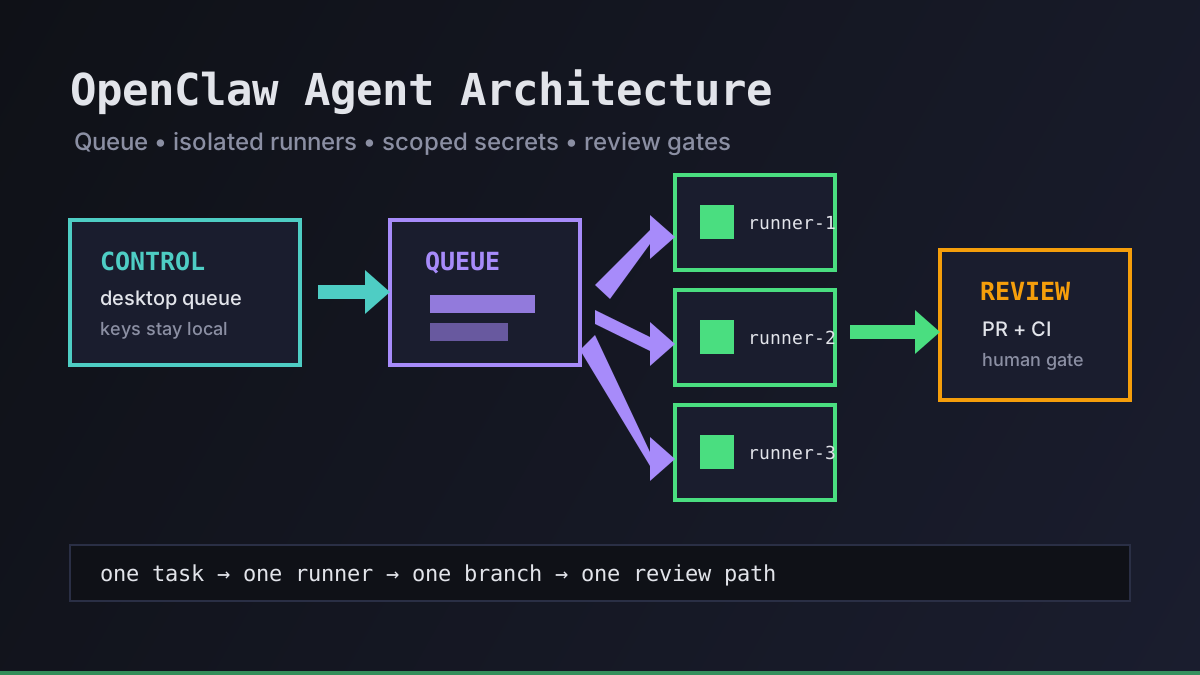
OpenClaw-style autonomy is useful only when the operating model is boring. The agent can explore, edit, test, and report back, but the architecture around it should make every boundary explicit: where the task starts, which runner owns it, which secrets it can see, and which gate decides whether the work ships.
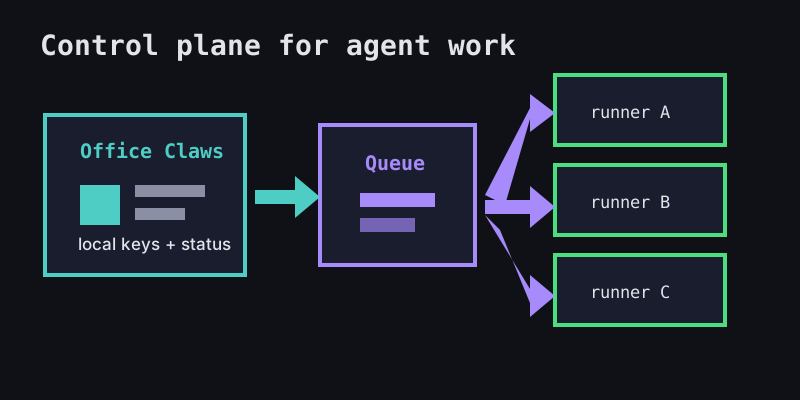
Office Claws is not a native OpenClaw runtime. We use it as the desktop and VPS control layer for OpenClaw-adjacent, Codex-backed workflows: queue the job, isolate the runner, stream logs, keep keys narrow, and make review the default. If you are still deciding on the runtime, start with OpenClaw vs Codex and Office Claws for OpenClaw users.
The OpenClaw Agent Architecture Shape
A safe OpenClaw agent architecture has five layers. Each layer should be replaceable without trusting the others too much.
| Layer | Responsibility | Design rule |
|---|---|---|
| Control plane | accepts tasks, shows status, stores operator state | keep long-lived keys local |
| Queue | limits concurrency and assigns ownership | one task should have one active runner |
| Runner | executes commands in a worktree or VPS | make it disposable |
| Secret boundary | grants only the access needed for this task | prefer scoped and short-lived tokens |
| Review gate | turns output into a PR, release note, or rejection | humans approve production changes |
That separation is what keeps autonomous coding from becoming a shared terminal with better branding. The queue makes work visible, the runner keeps state contained, and the review gate prevents a successful command from becoming an automatic deploy.
Reference Blueprint
Use this blueprint as a starting point, not as a diagram of a single product feature. The important part is the contract between components.
Office Claws desktop control plane
  ├─ task queue
  ├─ local provider keys
  ├─ approvals and status
  └─ log viewer
        │
        ▼
Runner pool
  ├─ local runner: small edits, docs, quick tests
  ├─ VPS runner: long tasks, stable network, CI triage
  └─ disposable worktree: one branch per task
        │
        ▼
Git provider
  ├─ branch + pull request
  ├─ CI checks
  └─ human review before merge
For remote execution, pair this with OpenClaw remote runner architecture. For ongoing task reliability, read OpenClaw background tasks and OpenClaw monitoring.
Boundaries That Matter Most
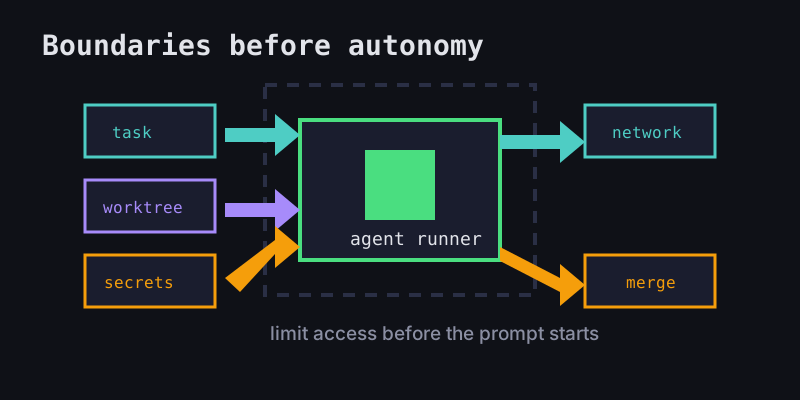
The highest-risk mistake is treating the agent as if it were a trusted developer laptop. It is not. It is a worker with a task, a context window, and the ability to make confident mistakes.
Start with these boundaries:
- Task boundary: define the repo, branch, allowed paths, and success gate before the runner starts.
- Filesystem boundary: use a clean worktree or disposable VPS image instead of a permanent shared checkout.
- Credential boundary: avoid putting billing, production, or org-wide tokens on the runner.
- Network boundary: know which external services the task really needs.
- Merge boundary: require PR review, CI, or another explicit gate before code reaches main.
This is why OpenClaw-style workflows benefit from an operator layer. Office Claws for OpenClaw users focuses on desktop control, VPS runner provisioning, logs, and Codex-backed execution, not on giving every agent a permanent shell with every secret.
Failure Modes to Design For
Good architecture assumes agents fail in ordinary ways. The system should make those failures visible and recoverable.
| Failure mode | Symptom | Safer response |
|---|---|---|
| Lost context | agent repeats work or changes scope | stop the task and summarize remaining work |
| Dirty runner | tests pass only because of local state | rebuild the runner or checkout |
| Token exposure | logs or diffs contain secrets | revoke token, delete runner, audit branch |
| Endless loop | command retries without progress | timebox and surface logs |
| Overbroad fix | small bug becomes large rewrite | reject PR and restart with a narrower task |
The goal is not to prevent every failed attempt. The goal is to make failure cheap: stop, inspect, reset, and try again with a tighter task contract.
What to Build First
If you are building an OpenClaw agent architecture from scratch, do not start with a complex scheduler. Start with the smallest loop that keeps work reviewable:
- A task record with owner, repo, branch, and expected output.
- One isolated runner per active task.
- A log stream that survives tab closes and laptop sleep.
- A validation command such as
npm run build,go test ./..., ornpx velite build. - A PR-based review gate before merge or deploy.
Once that works, add concurrency limits, runner pools, cost tracking, and cleanup automation. Those are valuable, but they are secondary to the core contract: one task, one runner, one branch, one review path.
Where Office Claws Fits
Office Claws turns this architecture into a daily workflow: local desktop management, VPS runners, durable background tasks, status visibility, and Codex-backed execution for teams that want OpenClaw-style autonomy without losing operational control.
It does not need to pretend every agent is safe by default. The safer assumption is that agents are powerful, useful, and sometimes wrong. Architecture gives them room to work while keeping secrets, branches, and production behind explicit gates.
That is the practical version of OpenClaw agent architecture: make autonomy observable, make runners replaceable, and make shipping a reviewed decision instead of a side effect.
Related Reading
- OpenClaw vs Codex — compare runtime and operating models.
- OpenClaw desktop manager — local control for OpenClaw-adjacent workflows.
- OpenClaw security best practices — reduce blast radius before agents touch real repos.