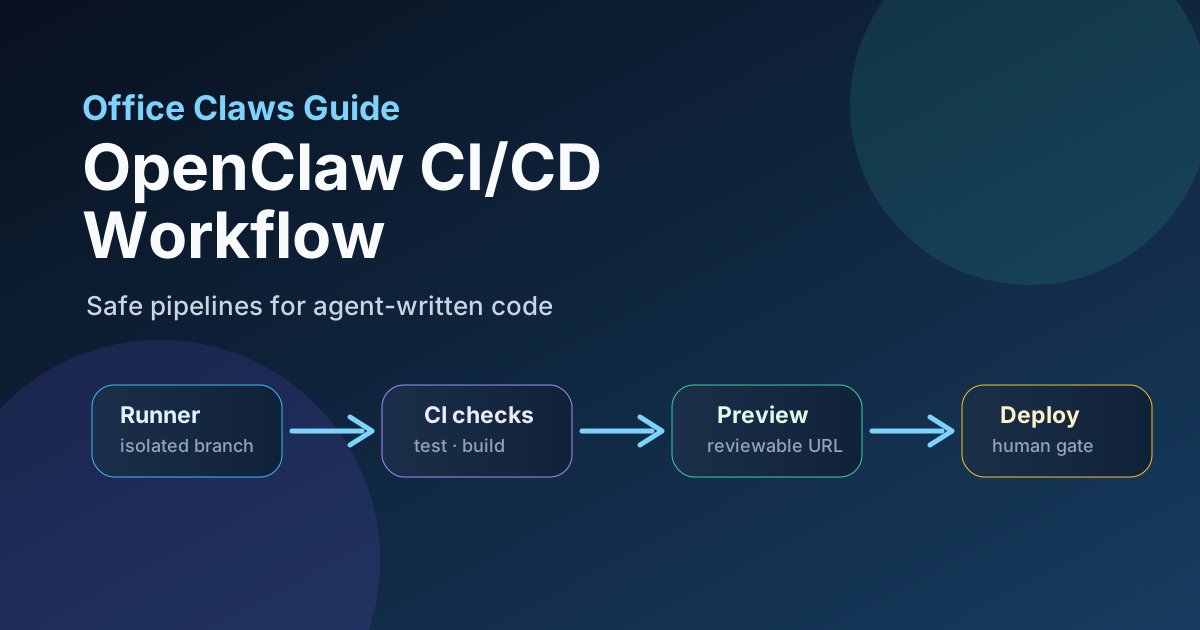
Why OpenClaw CI/CD Needs Its Own Pattern
OpenClaw-style coding agents can make useful progress while a team is busy elsewhere, but CI/CD is where that autonomy either becomes trustworthy or turns into a risky shortcut. The goal is not to let an agent deploy faster. The goal is to make every agent change small enough to review, easy enough to roll back, and boring enough for a pipeline to reject when something is wrong.
Office Claws is not a native OpenClaw runtime. The honest fit is operational: use Office Claws as the desktop and VPS manager around OpenClaw-adjacent, Codex-backed work, then let GitHub or your CI system enforce the merge and deployment rules. If you are still choosing a runtime, start with OpenClaw vs Codex, then use this workflow as the safety layer.

The OpenClaw CI/CD Contract
Every automated task should start with a CI/CD contract. It tells the runner where it may write, which checks must pass, and which decisions stay human-owned.
| Contract field | Safe default | Why it matters |
|---|---|---|
| Branch | agent/<ticket>-<purpose> | Keeps generated code off main |
| Pull request | Draft first, ready after validation | Makes CI visible early |
| Required checks | Typecheck, tests, lint, build, content validation | Catches boring failures before review |
| Preview | Ephemeral URL or artifact | Lets humans inspect behavior, not just code |
| Secrets | No production secrets on the runner | Prevents accidental exposure |
| Deploy | Human approval after green checks | Keeps release authority separate from code generation |
This is the same operating model behind Office Claws for OpenClaw users: one task, one runner, one branch, one log stream, and one review gate. The CI/CD system becomes the neutral referee.
A Minimal Pipeline for Agent Branches
A useful pipeline should be strict before it is clever. Start with a pull-request workflow that blocks merge until the repository proves it can build.
name: agent-ci
on:
  pull_request:
    branches: [main]
permissions:
  contents: read
  pull-requests: read
jobs:
  validate:
    runs-on: ubuntu-latest
    steps:
      - uses: actions/checkout@v4
      - uses: actions/setup-node@v4
        with:
          node-version: 22
          cache: npm
      - run: npm ci
      - run: npm run lint --if-present
      - run: npm test --if-present
      - run: npx velite build
      - run: npm run build
For backend services, add migrations in dry-run mode, contract tests, and container builds. For content-heavy sites, keep the content build separate from the Next.js or static build so a metadata error is easy to spot. Office Claws-managed runners can surface the same validation output next to the task log, which makes handoff cleaner when a human opens the PR later.
Preview Before Deploy
Preview environments are the best compromise between agent speed and human control. Let the agent produce the branch and PR, let CI produce a preview, and let a human decide whether the change should ship.

A good preview gate answers four questions:
- What branch and commit produced this preview?
- Which checks passed, failed, or were skipped?
- What files changed outside the expected scope?
- What is the rollback path if this merges badly?
If a runner needs cloud credentials to create previews, scope them narrowly. Prefer provider tokens that can create preview deployments but cannot touch production. If that is not possible, stop the agent at the PR and let a human run the deploy step.
Failure Rules That Keep CI/CD Safe
The most important CI/CD rules are stop rules. An OpenClaw-style agent should stop and ask for review when it hits any of these conditions:
- A failing test appears unrelated to the task.
- A migration deletes, renames, or rewrites production data.
- The fix requires broad secrets, admin tokens, or release keys.
- The diff crosses service boundaries without an explicit plan.
- The same validation fails three times after different fixes.
Pair these rules with OpenClaw monitoring and OpenClaw security best practices. Monitoring catches stuck runs; security rules keep the pipeline from becoming a privileged shell.
Recommended OpenClaw CI/CD Workflow
- Create a fresh branch before the agent writes code.
- Push a draft pull request as soon as there is a meaningful checkpoint.
- Run lint, tests, content validation, and build in CI, not only locally.
- Generate a preview artifact or URL for UI/content changes.
- Require human approval for production deploys and destructive migrations.
- Keep Office Claws runner logs, branch names, and PR links together for auditability.
The pattern is deliberately conservative. Agents can move fast inside a sandbox, but CI/CD decides what is reviewable and humans decide what ships. That is how OpenClaw-style autonomy becomes a team workflow instead of a pile of terminal output.
Related Reading
- OpenClaw vs Codex — compare runtime and operating tradeoffs.
- OpenClaw Desktop Manager — Office Claws for OpenClaw users.
- OpenClaw GitHub Workflow — branches, PRs, and review handoffs.