Why OpenClaw API Cost Needs Its Own Model
OpenClaw-style work changes the way teams spend money on AI. A developer is no longer asking one assistant for one answer. They are launching background agents, keeping several branches alive, retrying builds, and handing logs between local machines and remote runners. That is powerful, but it also makes the bill harder to reason about.
The safest way to think about OpenClaw API cost is not "tokens are expensive". It is: every autonomous task should have an owner, a runner, a budget, a branch, and a review gate before the first prompt runs. If you are still comparing runtimes, start with OpenClaw vs Codex. If you already want a local operator layer, see Office Claws for OpenClaw users.
Office Claws is not a native OpenClaw runtime. The honest fit is OpenClaw-adjacent operations: local desktop control, isolated VPS runners, Codex-backed execution where it makes sense, and visible spend controls around each task.
The Four Costs Behind an Agent Run
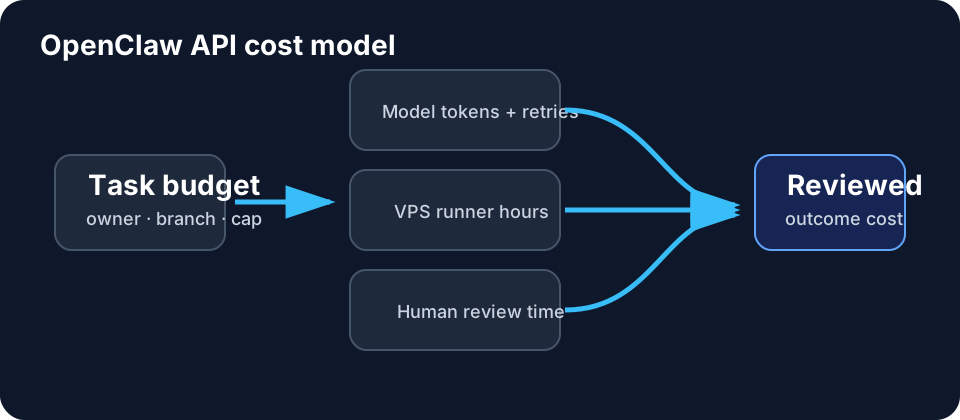
Most teams only track provider invoices. That misses the real cost of autonomous coding. A useful model has four buckets:
| Cost bucket | What it includes | How to control it |
|---|---|---|
| Model API spend | Prompt, completion, tool output, retries, summarization | Per-task token budgets and escalation rules |
| Runner spend | VPS time, storage, bandwidth, snapshots | One runner per task, auto-stop, reusable images |
| Human review | Reading diffs, checking logs, rerunning CI | Smaller branches and explicit acceptance tests |
| Failure recovery | Stuck agents, bad credentials, broken deploys | Monitoring, checkpoints, rollback plans |
The cheapest model is not cheap if it creates a 2,000-line branch nobody trusts. The most expensive model can be economical if it solves a hard migration in one focused run. OpenClaw API cost should be measured by reviewed outcome, not by token line item alone.
A Simple OpenClaw API Cost Formula
Use this planning formula before launching parallel agents:
run_cost = model_tokens + model_retries + runner_hours + review_minutes + recovery_risk
team_cost = sum(run_cost per branch) + idle_runner_overhead
For day-to-day planning, turn that into a launch checklist:
- Define the task in one screen of text.
- Pick the cheapest model tier that can plausibly finish it.
- Set a retry limit before escalation.
- Attach only relevant files, docs, and logs.
- Run on an isolated local or VPS runner.
- Stop when the branch exceeds the review budget.
This pairs well with OpenClaw token optimization: token discipline lowers API spend, but branch discipline lowers the larger hidden review cost.
Subscription vs API vs VPS: When Each Wins
There is no universal cheapest option. The right answer depends on workload shape.
| Workload | Better fit | Why |
|---|---|---|
| Occasional interactive help | Subscription | Predictable, simple, low operational overhead |
| Many bounded background tasks | API + runner budgets | Pay for completed work, cap each branch |
| Long-running repo migrations | VPS-managed agents | Isolation, logs, checkpoints, recoverability |
| Security-sensitive changes | Local-first control | Keep secrets, approvals, and release gates close |
| Team-scale parallel work | Office Claws-managed workflow | Central visibility across runners, branches, owners, and spend |
For broader numbers, use the OpenClaw cost comparison. The short version: subscriptions are easy until they block, throttle, or hide per-task economics. API-backed runners require more discipline, but they also let teams assign budgets to real work instead of guessing from a monthly invoice.
Cost Controls That Prevent Surprise Bills
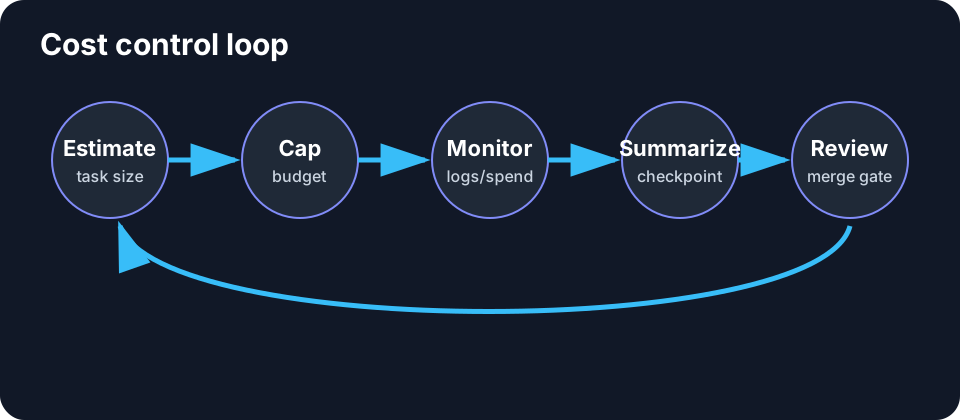
Start with controls that change agent behavior, not just dashboards that describe damage after it happened.
- Per-task budget caps. Give every agent a maximum spend or time window.
- Escalation rules. Let a runner try a cheaper model first, then require an explicit reason to escalate.
- Context budgets. Send paths and concise briefs instead of entire chat histories.
- Idle shutdown. Stop remote runners when they are waiting for credentials, review, or human input.
- Branch size limits. A large diff is a cost signal, even if the token bill looks fine.
- Checkpoint summaries. Long tasks should summarize state before continuing or handing off.
- Scoped secrets. Avoid broad tokens on remote machines; see OpenClaw secrets management.
Office Claws helps by making these controls visible at the operator layer: which runner is active, which branch it owns, what model path it is using, whether it is still producing useful output, and when a human review gate should stop the spend.
Example Budget for a Small Team
A small team running OpenClaw-style agents can use a simple weekly envelope:
| Category | Weekly starting budget | Notes |
|---|---|---|
| Routine bug fixes | 20-30 short runs | Cheap model first, strict branch limits |
| Refactors | 5-8 medium runs | Add checkpoints and CI gates |
| Research/prototypes | 3-5 exploratory runs | Require summaries before implementation |
| Emergency fixes | Reserved budget | Stronger model allowed, human in the loop |
| Runner overhead | Fixed VPS pool | Auto-stop anything idle |
The point is not to forecast every token. The point is to prevent a background task from silently turning into a multi-day investigation. OpenClaw monitoring should surface stuck loops, repeated failures, and idle runners before they become surprise costs.
Recommended Office Claws Workflow
For OpenClaw API cost control, use this default pattern:
- Create one task with one owner and one branch.
- Launch one isolated runner from the desktop.
- Assign a model tier, retry count, time budget, and stop condition.
- Stream logs and cost signals while the runner works.
- Summarize before handoff, escalation, or review.
- Stop the runner after CI, PR creation, or manual rejection.
That workflow keeps API cost tied to accountable work. It also makes migration safer for teams moving away from blocked or expensive subscription paths toward Codex-backed agents. Office Claws is the practical control plane for that world: local where secrets matter, remote where isolation helps, and explicit about the cost of every autonomous branch.
Related Reading
- OpenClaw vs Codex — understand runtime and pricing tradeoffs.
- OpenClaw Desktop Manager — manage OpenClaw-style work locally.
- OpenClaw Cost Comparison — compare subscription, API, and VPS economics.
- OpenClaw Token Optimization — reduce wasted context and retries.