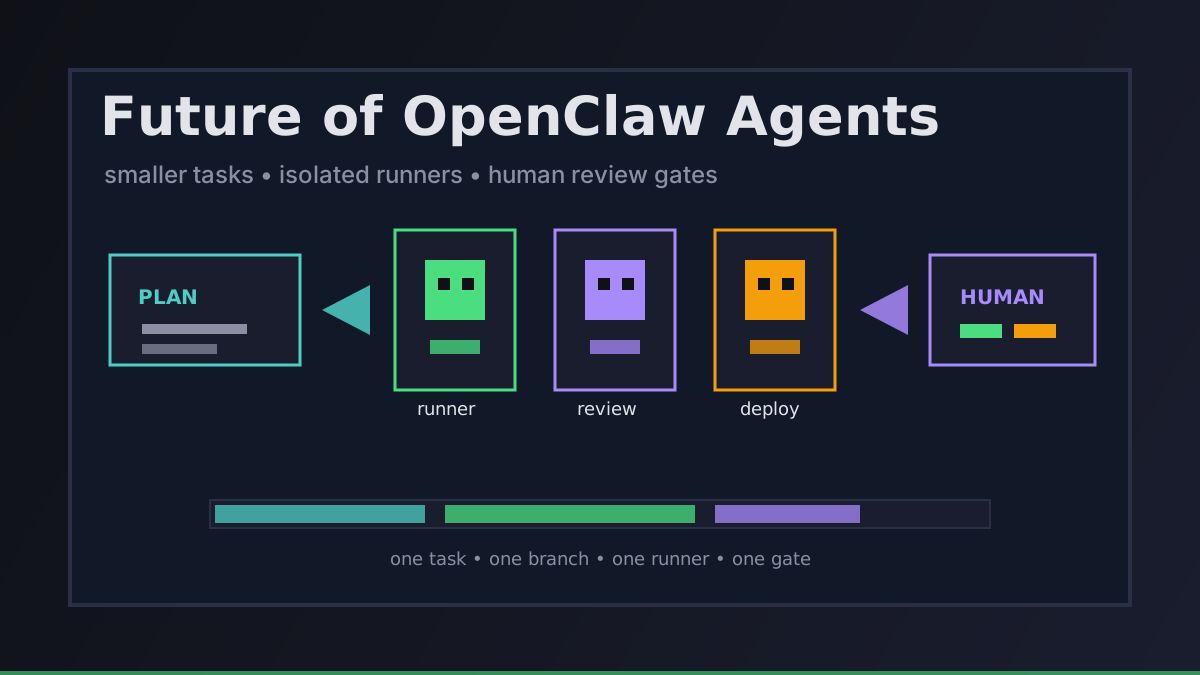
The future of OpenClaw agents is not one giant autonomous worker with every permission. The useful direction is quieter and more operational: smaller tasks, clearer contracts, safer runners, visible logs, and review gates that humans can trust.
Office Claws is separate from OpenClaw and does not claim to be a native OpenClaw runtime. We focus on the operator layer around OpenClaw-style work: local desktop control, VPS runners, Codex-backed execution when that is the practical path, and a workflow that keeps merges and deployments reviewable. If you are choosing a runtime first, start with OpenClaw vs Codex. If you need an operations layer, see Office Claws for OpenClaw users.
The Future Is Many Small Agents, Not One Giant Agent
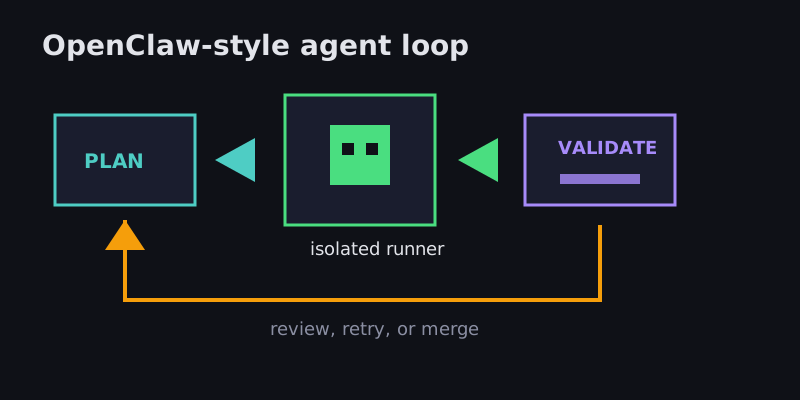
OpenClaw-style work gets safer when each agent has one job. A task should fit on a branch, have one owner, touch predictable paths, and finish with evidence. That sounds less magical than a universal agent, but it is how teams turn autonomous work into shipped work.
| Agent pattern | Where it helps | Risk to manage |
|---|---|---|
| Research agent | reading issues, docs, logs | stale or uncited conclusions |
| Patch agent | focused code or content change | unrelated files in the diff |
| Test agent | reproductions and validation | fake confidence without logs |
| Review agent | second-pass checklist | noisy comments with no decision |
| Deploy agent | prepared release steps | production credentials and rollback |
The best OpenClaw agent architecture looks more like a queue of specialists than a single all-powerful terminal. OpenClaw multi agent workflow and OpenClaw background tasks are the practical building blocks.
Runners Become Disposable Work Cells
The next step is runner hygiene. Future OpenClaw agents should not share one long-lived checkout full of old state, broad tokens, and hidden terminal history. Each meaningful task should get a clean workdir or small VPS runner, a branch, a budget, and a known stop condition.
future_agent_task:
  branch: agent/pricing-copy-refresh
  runner: disposable-vps-small
  allowed_paths:
    - website/content/**
    - website/public/blog/**
  budget:
    minutes: 45
    max_retries: 2
  gates:
    - npx velite build
    - npm run build
This is why Office Claws treats remote machines as controlled work cells. Tailscale access, DigitalOcean droplets, snapshot-based provisioning, and visible logs make it easier to stop a bad run without contaminating another task. The goal is not more machines for their own sake. The goal is a smaller blast radius.
Memory and Autonomy Need Audit Trails
Agents will remember more context over time. That can be useful, but memory without auditability becomes another hidden dependency. The future we want is explicit: what the agent used, which files it read, what changed, which command passed, and what assumption needs human review.
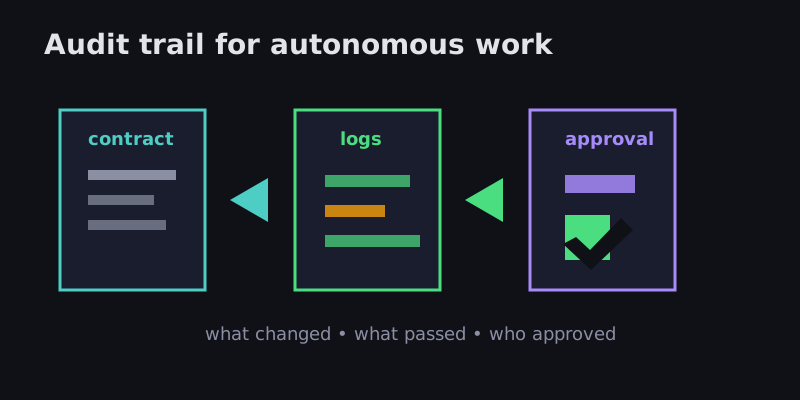
Use this default policy for long-running autonomous work:
- Put the task contract in writing before the run starts.
- Keep secrets scoped to the runner and task.
- Stream command output and summarize failures with evidence.
- Require a git diff and validation result before completion.
- Keep deployment approval separate from coding approval.
That policy pairs naturally with OpenClaw security best practices, OpenClaw secrets management, and OpenClaw monitoring. Autonomy becomes safer when the operator can replay the story.
What Office Claws Should Optimize For
Our bet is that OpenClaw-style workflows will be won by operations, not spectacle. Developers need to launch work quickly, but they also need to see where it is running, what it costs, whether it is stuck, and when a human decision is required.
For Office Claws, that means optimizing for:
- local-first control of agent queues and keys;
- VPS runner provisioning that is boring and repeatable;
- Codex-backed agents with predictable cost boundaries;
- logs, diffs, and validation results in one place;
- manual review gates before merges and deployments.
Self-hosted Office Claws stays at $4.99/month and managed Office Claws at $14.99/month, so the economics stay legible while teams scale runners separately. The product truth matters: Office Claws is not OpenClaw itself. It is the desktop and VPS control layer for teams that want OpenClaw-style autonomy without losing operational control.
Recommendations
If you are planning for the future of OpenClaw agents, do not start by asking how much autonomy you can grant. Start by asking what you can safely observe, stop, review, and repeat.
A good near-term roadmap is simple:
- Standardize one-task-one-branch work.
- Move risky or long-running jobs to isolated runners.
- Keep production secrets out of ordinary coding tasks.
- Require validation logs before review.
- Use Office Claws to manage the queue, runners, and review gates.
That is the future worth building: not agents that escape oversight, but agents that make more useful work reviewable.
Related Reading
- OpenClaw vs Codex — compare runtime and operations tradeoffs.
- Office Claws for OpenClaw users — desktop management for agent work.
- OpenClaw background tasks — durable async work without hidden panes.
- OpenClaw security best practices — safer credentials, approvals, and runners.